The Forgetting Curve Applied to Meeting Content
Most meeting details vanish within hours, leaving organizations to rebuild decisions repeatedly.
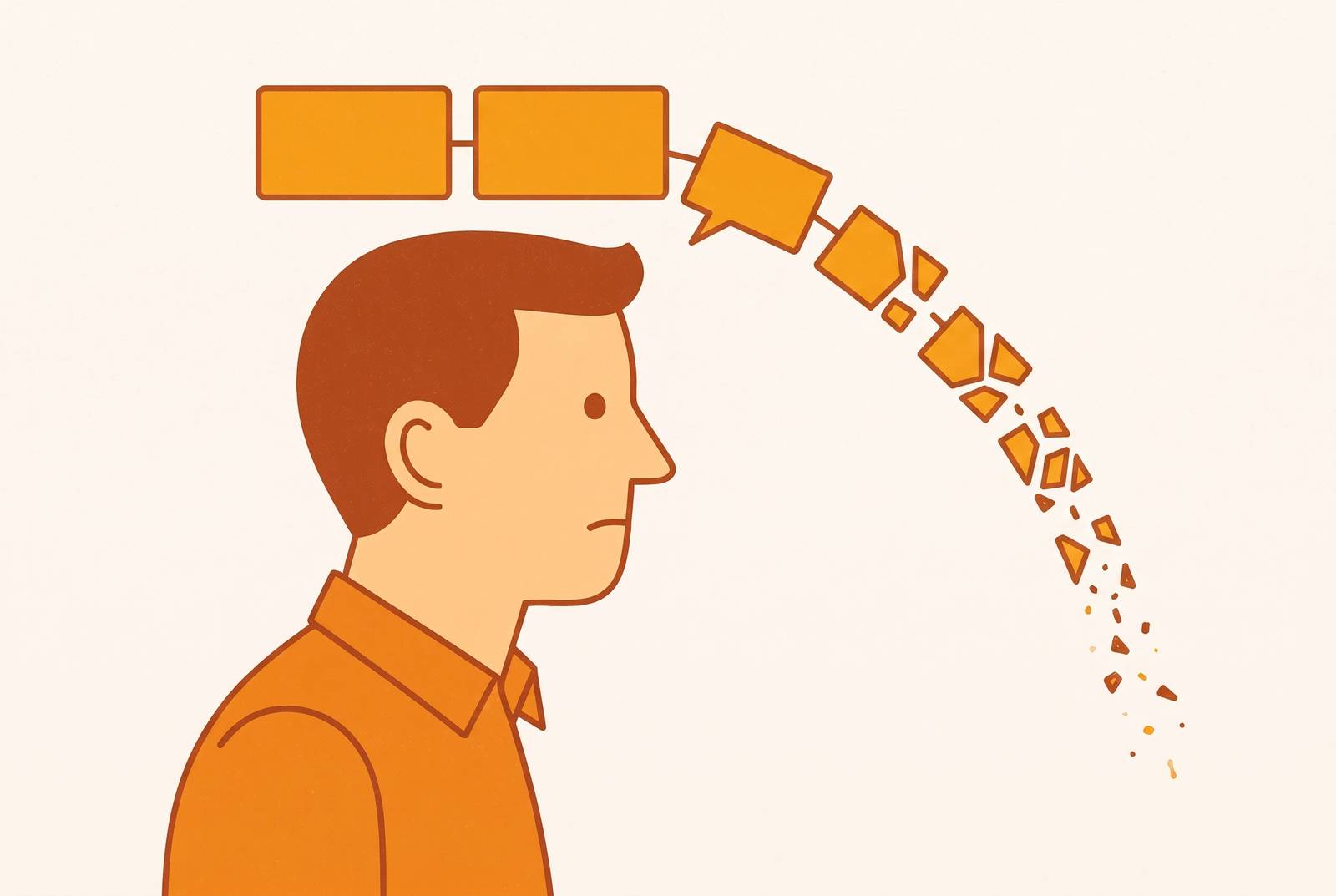
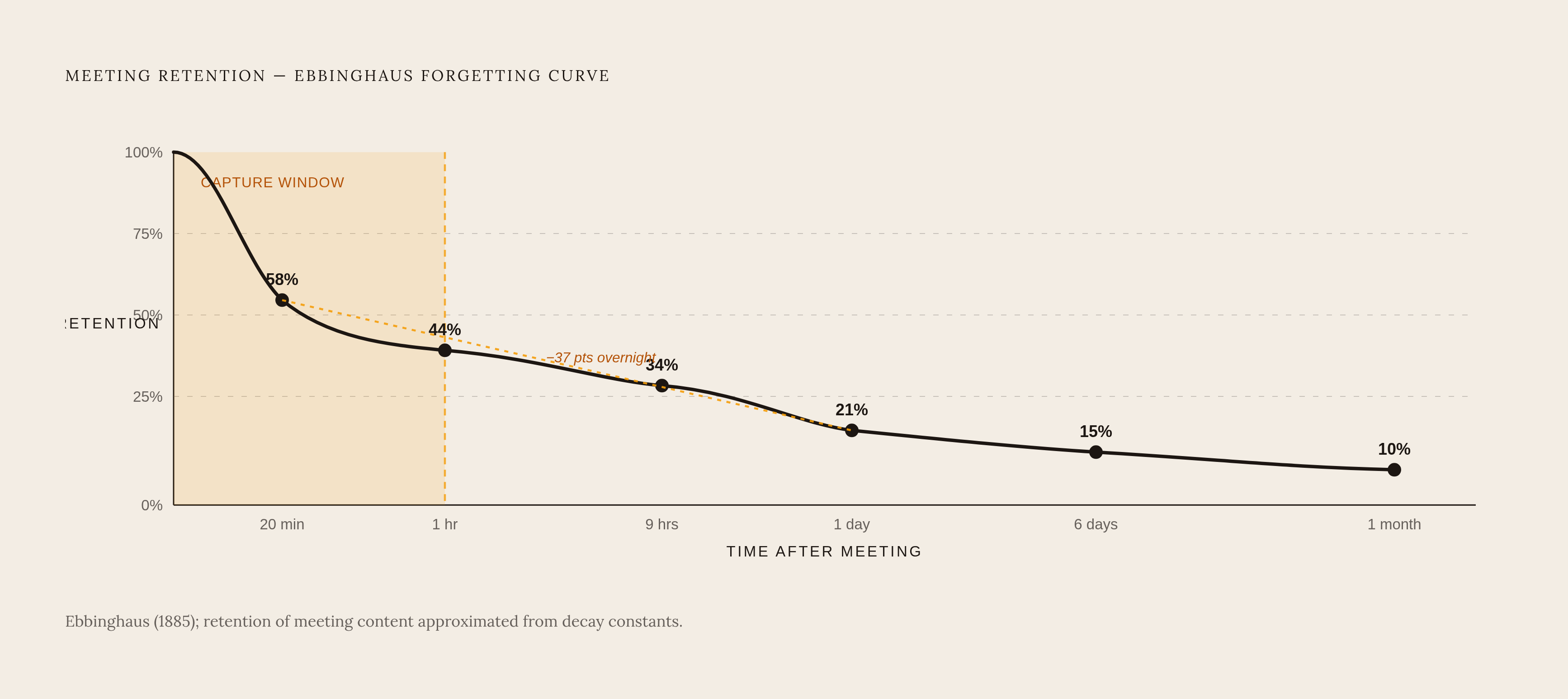
Ebbinghaus published his forgetting curve in 1885, and it still predicts, with unsettling precision, how little of Tuesday's standup survives to Wednesday. He drilled himself on nonsense syllables, "WID," "ZOF," strings deliberately stripped of meaning so nothing in his memory could hook onto them. The decay he charted has been documented and referenced across subsequent research: 58% retention after 20 minutes, 44% after an hour, 34% after nine hours, 21% by the next day. Six days out, 15% survives. A month later, 10%.
That curve was never built to describe meetings, and it should have been. Ebbinghaus ran a controlled memorization experiment. A Tuesday sync where six people talk over each other about a Q3 roadmap is a fundamentally different kind of event. But meetings likely decay worse than his syllable lists, not better, because a syllable list at least warns you upfront that it needs memorizing. A meeting gives no such warning. You walk in cold, and nobody tells you which sentence in the next 45 minutes you'll need to recall accurately three days from now.
Why meeting content is vulnerable to the forgetting curve
Lay the Ebbinghaus timeline over an ordinary workday and the arithmetic turns grim fast. A decision made on a 10 a.m. call has already lost roughly half its detail in the mind of the person responsible for it by the time they sit down for lunch. Left uncaptured, 21% retention is the ceiling by the next morning, and the following week erases nearly everything that wasn't anchored somewhere outside that person's skull.
Meeting content decays fast for the same reason nonsense syllables did. It's dense, delivered aloud at a pace the listener doesn't control, and almost never revisited right after it happens. A training module warns you in advance what matters. A meeting doesn't.
The standard fix, taking notes, actually makes things worse. Typing while listening splits attention the same way checking a phone mid-conversation does, and the person typing is, by definition, not fully processing what's being said while they're busy transcribing it. The safeguard degrades the very thing it exists to protect. Most teams have built their entire meeting culture around this and never questioned it.
Words are only part of what disappears, and arguably not the most important part. A pause before someone answers a hard question. An offhand comment that reveals more than the speaker meant to say. A shift in tone when a topic turns uncomfortable. None of that survives in a transcript, and none of it gets caught by scribbled notes either, yet those signals are often what's needed to interpret what a decision meant later. Multiple sources put meeting-content loss at 50% to 70% within 24 hours. If that decay follows a predictable shape, so does the window for intervention, and that predictability, not habit, should set the timing of any follow-up.
The organizational cost when meeting knowledge disappears at scale
Start with volume, because volume is what turns a psychology finding into a balance-sheet problem. Microsoft's Work Trend Index found professionals now spend more than half a typical work week in meetings, a share that has climbed sharply since 2020. More meetings just means more raw content pouring into a decay pipeline that was never built to hold it.
A large share of the action items discussed in meetings go uncaptured in any written form. The ones that do still face the same curve if nobody revisits them, so capture alone is not the fix most teams assume it is. Decay doesn't wait for the meeting to end before it starts working, and most workers, asked cold, can't reliably list every task assigned to them earlier that same day.
Reconstruction has its own price tag. Employees burn meaningful time rebuilding what was already said once, in a meeting they already sat through, hours spent on recovery instead of output. Institutional knowledge loss ranks among the top offboarding challenges organizations face, and meetings are one key place where tacit knowledge resides before it becomes inaccessible once the people who held it move on.
App sprawl compounds the damage. The average company runs a large and sprawling stack of software applications in active use. Meeting output that isn't captured and routed somewhere deliberate doesn't just vanish. It fragments across those hundred silos, which is worse than never existing at all, since now someone has to go looking for it without knowing where to look. McKinsey research found knowledge workers lose close to a fifth of their week just searching for information they need, and some real share of what they're hunting for was said out loud in a room they were sitting in.
U.S. companies spent $102.8 billion on corporate training in 2024–2025, money spent purely to get knowledge into employees' heads. The forgetting curve erodes a meaningful slice of that investment within hours of it landing. Unrecorded meetings are a second leak in the same bucket, and it's one nobody's measuring.
The curve's shape and when to intervene
The shape of the curve is what tells you when intervention still works, and most meeting-follow-up habits get the timing badly wrong. Loss front-loads brutally: research consistently shows that a large share of forgetting happens within the first hour. The window for a useful save is far narrower than the slack time most teams assume they have.
Three things follow from that shape. Capture has to happen at or immediately after the meeting, because any delay past that first steep drop compounds losses nothing can recover afterward. Retrieval matters just as much as capture, since a summary nobody reopens decays exactly like unaided memory, so the record has to be built to invite a second look. And spaced repetition applies here the same way it applies in a classroom: a decision revisited soon after the meeting, then again later, consolidates far better than one filed away and never reopened.
Research cited in Intrepid learning material shows emotional salience slows the curve. Information tied to something personally relevant to the listener decays less steeply than generic material, which is a plain argument for assigning an action item to a specific named owner at the exact moment it's captured, rather than leaving ownership vague until later.
A recap sent two days later arrives too late to function as the initial capture. It can still help through spaced repetition down the line, but the critical early period where memory consolidation is most susceptible has already passed by the time that recap lands.
How AI meeting notes address the capture window
The mechanism is simple enough to state in one sentence: an AI assistant joins the call, transcribes continuously, identifies who's speaking, and produces a summary with decisions and action items, often before anyone has left the room. That timing is the whole point. It attacks the steepest, most damaging stretch of the curve by shrinking the gap between something being said and something being written down to nearly zero.
Two capture methods exist as of 2026, and neither one simply beats the other, they suit different situations. Bot-based recording puts a visible participant into the call itself. Device-level capture pulls audio straight from the device with nothing visible in the meeting window. A client-facing call calls for the latter, where a visible bot reads as intrusive; an internal sync often doesn't care either way. Teams are better served understanding that tradeoff than defaulting to whichever tool they happened to try first.
A finished output typically includes a verbatim transcript, a one-page summary, and action items tagged with owners and deadlines. More advanced tools add sentiment analysis, talk-time breakdowns, drafted follow-up emails, or automatic CRM updates, though this varies widely by vendor. The bigger shift happens to the person sitting in the meeting: freed from typing, they can actually listen, and that alone improves how the information encodes in the first place, independent of whatever summary shows up afterward.
Transcription accuracy on single-speaker audio has improved substantially across leading tools. Multi-speaker calls with crosstalk still drag that number down, though the leading tools have made meaningful progress on raw English transcription. That shift moves the real competition elsewhere. A writeup that used to take a person 15 to 30 minutes to draft by hand now arrives in seconds, and arriving in seconds is what keeps a summary landing inside the forgetting window instead of well outside it.
Summary quality as the actual retention lever
A verbatim transcript beats nothing, but it doesn't solve the problem, it just relocates it. A 90-minute call produces a 90-minute record, and almost nobody sits down to re-read 90 minutes of dialogue. Spaced repetition only works if the follow-up is short enough that someone will actually open it a second time, and a full transcript fails that test by design.
Judge a summary on three things: does it separate decisions from the discussion that produced them, does it surface action items with named owners instead of burying them mid-paragraph, and can someone skim the whole thing in under two minutes. That last question decides whether the summary gets opened a second time, and that's the entire mechanism spaced repetition runs on.
Under the hood, a labeled transcript gets fed to a language model that generates the summary, pulls out decisions, and assigns action items with deadlines attached. Vendors now differ not on whether they transcribe accurately, since that's close to table stakes across leading products in 2026, but on what the model and the prompting strategy behind it do with the raw material. Different tools produce summaries that can read like they came from two different meetings when fed the same transcript.
Four camps make up the market, and they are not interchangeable despite marketing that suggests otherwise. Transcription-first products prioritize an accurate record with a lighter automation layer on top. AI summary note-takers, the largest and most crowded category, handle recording, transcription, and readable summaries with action items in one pass. Conversation intelligence tools built for sales teams add coaching and deal-signal layers on top of the summary. Documentation tools turn rough notes into polished docs inside a broader workspace. Anyone evaluating options should ask to see a real summary from an actual meeting, not a scripted demo transcript, since that's the artifact that either beats the curve or doesn't.
Routing captured meeting knowledge into the systems where work happens
A flawless summary sitting in a folder nobody opens has saved nothing. The forgetting curve doesn't care how good the record is if the record never gets retrieved. A folder outside anyone's daily workflow is, functionally, a place where information goes to be forgotten more slowly than it would have been otherwise, which is a small mercy and not a solution.
Even a good summary doesn't close the gap by itself. Someone still has to create tasks, send recaps, update records, and chase down whoever owns the next step, and automation is what actually closes it, not the summary alone. Action items pushed straight into a tracker like Asana, Linear, or Jira appear where the person already works, so retrieval happens on its own instead of depending on someone remembering to check a separate app. A recap posted to Slack or emailed to attendees creates the first scheduled moment of re-exposure, often within hours, which is exactly the kind of early repetition the curve rewards. A CRM record updated automatically after a sales call lands where a rep will actually look next.
The sales-to-customer-success handoff makes the stakes concrete. Without a clean record, the success team ends up re-asking the client questions the sales rep already answered weeks earlier, a bad first impression dressed up as a scheduling issue. A generated summary that captures the client's stated goals, specific concerns, and any promises made on the call gives the next person on the account a real starting point instead of a blank page. That's the tacit knowledge that otherwise leaves with whoever sat in the room originally.
What separates a genuinely good tool at this stage is not the length of its integration list. It's precision: does it create the right task, in the right project, assigned to the right person, with the relevant client context attached, or does it just dump a generic bullet list into someone's inbox. Teams with unusual stacks can use APIs and webhooks to build custom routing rather than forcing everything through a one-size integration. A task that resurfaces during a sprint review, or a CRM field a rep rereads before the next call, functions as spaced repetition that happens automatically, without anyone scheduling it, which is the whole point.
Meeting data as searchable organizational memory (beyond individual recall)
One person forgetting a meeting is a personal problem. An entire organization forgetting the same meeting, because the one person who remembered it left the company, is a structural one, and it costs far more to fix after the fact than it would have to prevent.
Institutional knowledge loss is widely named among organizations' top offboarding challenges, and HR leaders estimate offboarding costs (knowledge loss, security exposure, rehiring combined) can run into the hundreds of thousands of dollars a year at their companies. Meetings hold a huge share of that tacit knowledge: strategy rationale, customer history, the reasoning behind a call made eight months ago that never got written down anywhere searchable.
A searchable archive changes what's actually recoverable. New hires can search past discussions on a topic instead of re-asking colleagues or waiting on someone's calendar to get briefed, and Brandon Hall Group research reports real reductions in onboarding time among organizations further along in adopting this kind of system. Anyone who missed a meeting can pull the context directly instead of relying on a colleague's half-remembered version of events. Teams can return months later and surface not just that a decision happened, but the actual conversation that produced it, quoted directly, word for word.
Okta's 2025 report puts the average company at roughly a hundred separate applications, and the same app-sprawl problem appears here again, just wearing a different shape. Okta's 2025 report puts the average company at roughly a hundred separate applications, and meeting content that isn't indexed and searchable doesn't just get forgotten by the individual who attended. It joins the pile scattered across those hundred tools that nobody will ever think to check. Organizational memory as a category is still young in 2026, but enterprise CIOs are already ranking institutional knowledge retention among their top priorities for AI investment, and the logic isn't complicated. The forgetting curve was never just a psychology finding. It's a liability sitting on the balance sheet of every company that hasn't figured out where its meetings actually go once they end.