Forgetting Curves in Workplace Decision Making
Most workplace decisions vanish from memory within hours without reinforcement.

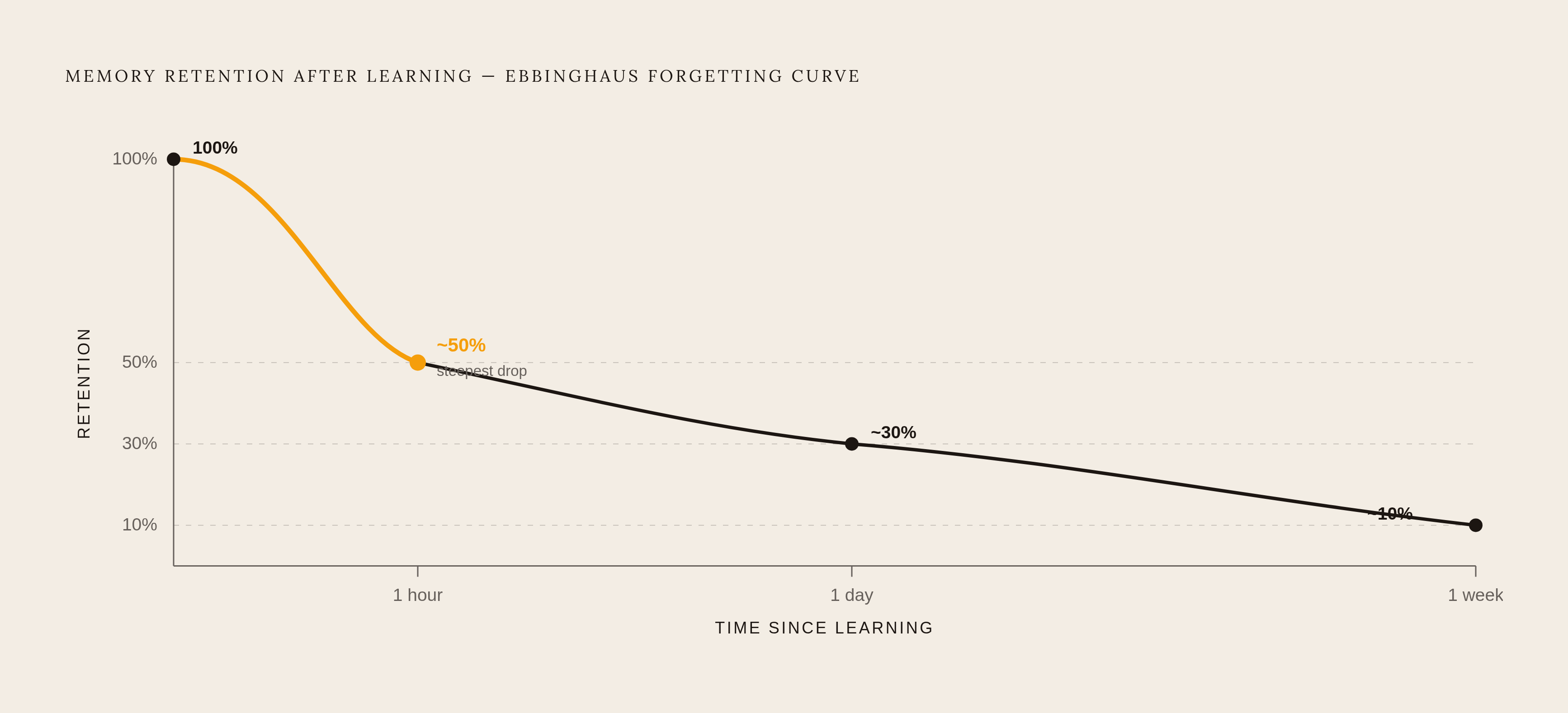
Human memory forgets fast, and it forgets fast in a very specific, measurable way. In 1885, German psychologist Hermann Ebbinghaus ran experiments on himself, memorizing lists of nonsense syllables and testing his own recall over time, and he found that retention drops off exponentially rather than in a straight line. That pattern, now called the forgetting curve, applies to workplace meetings just as much as it applied to his syllable lists, and it's the reason decisions made at 10 a.m. can feel like a hazy rumor by lunchtime.
Ebbinghaus found something specific: without any reinforcement, people forget roughly half of new information within an hour, about 70% within a day, and around 90% within a week. The decay isn't linear. It's steep right after exposure, then it levels off, which is what the exponential decay formula behind the curve describes: retrievability equals e raised to negative time over memory strength. The brain isn't malfunctioning when this happens. It's doing what it's built to do, pruning what looks unused to make room for what gets touched again and again. Modern neuroscience keeps confirming Ebbinghaus's basic finding, with one meaningful wrinkle: information that feels personally relevant or emotionally charged decays more slowly. That detail explains exactly which parts of a meeting survive and which don't.
What meetings produce, and why that output is especially vulnerable to decay
Every meeting that ends with anything useful produces three kinds of output, and they don't decay at the same rate. Decisions are the easiest to hold onto, because someone usually writes down what got agreed to. Action items come next: who owns what, and by when. Rationale, the reasoning that justified the decision in the first place, is the most fragile of the three, and also the one nobody bothers to write down. That's a problem, because rationale is what makes a decision defensible six months later when someone asks why the team went one direction instead of another.
Research has found that a majority of employees often leave meetings without a clear idea of what happens next. The forgetting curve doesn't even get a clean starting point in over half of meetings, because the content was never fully formed to begin with. You can't decay something that was fuzzy from the start; you just get compounding fuzziness.
Stress makes this worse. Under pressure, tight deadlines, high-stakes calls, the brain tends to prioritize immediate demands over deliberate recall, and it explains a familiar pattern in training contexts: people forget what they learned exactly when they need it most. The same mechanism appears in behavior after meetings. A team walks out of a tense budget discussion and, twenty minutes later, can't accurately reconstruct who agreed to what, because the nervous system was busy managing stress instead of encoding memory.
Cognitive load stacks on top of that. Complex, abstract discussions decay faster than concrete ones, because there's no existing mental scaffolding to hang the new information on. And meetings are rarely single-threaded. One session might produce three decisions and eight action items, all competing for the same limited working memory. The gap between what got decided and what people actually remember widens with every passing hour, and most organizations have no system built to close it.
Why the meeting volume problem makes memory decay costly at scale
The scale of this problem is bigger than any individual meeting. Research into meeting loads has put the average employee's meeting time at roughly a quarter to a third of a standard workweek. Middle managers and senior leaders spend a disproportionately large share of their time in meetings, with that share rising with seniority. The people making the most consequential calls in an organization are also the ones sitting in the most meetings, which means they're also the most exposed to decay.
And the output quality doesn't match the time spent. Survey data has found only a small fraction of meetings get rated as highly productive by the people who attended them. So most meeting hours produce content that's already thin, and that thin content then gets hit by the same exponential forgetting curve as everything else. A 2024 London School of Economics report estimated unproductive meetings cost U.S. businesses $259 billion a year. businesses $259 billion a year, which turns this from an abstract cognitive science problem into a line item. Worse, the research cited alongside that figure suggests time wasted in unproductive meetings has roughly doubled since 2019. The research cited alongside that figure suggests time wasted in unproductive meetings has roughly doubled since 2019, and the trend keeps compounding on its own.
Some roles feel this more than others. Sales teams, customer success, consultants, founders: these are meeting-heavy jobs where the decisions made in conversation feed straight into revenue and client relationships. When context from an earlier call gets lost, the cost isn't just that one meeting. It's every follow-up meeting spent re-litigating something that was already settled, because nobody could produce a clean record of what was agreed and why. Shorter meetings or fewer meetings won't fix that. The problem isn't time management. It's memory architecture, and those are different problems that need different fixes.
What training science learned about fighting forgetting, and how those lessons map onto meetings
Learning and development researchers have spent decades wrestling with the forgetting curve, and a handful of interventions have held up consistently. Spaced repetition, revisiting material at increasing intervals, embeds information more deeply than one exposure ever could. Retrieval practice, actually recalling information instead of just rereading it, strengthens the memory trace itself. Immediate application sharpens retention fast: knowledge used right away sticks better than knowledge filed away for later. And relevance still matters here the way it mattered to Ebbinghaus: information tied to something a person actually cares about, or needs to act on soon, decays more slowly.
Research from Go1 gets at something important: learning that lives in a vacuum, cut off from daily tasks, doesn't produce lasting change. The same is true of a meeting decision that only exists in someone's head, or buried three replies deep in an email thread nobody reopens. Peak Revenue Learning's analysis pushes this further, arguing that in workplace settings, performance shapes outcomes while memory alone doesn't. What someone does with a piece of information shapes the outcome they get, while being able to recite it back on its own changes nothing. Applied to meetings, that means the real test of a decision isn't whether people remember the decision was made. It's whether they act on it.
Line those training interventions up against meetings and the mapping is direct. Spaced repetition becomes structured follow-up: a summary sent right after the call, then surfaced again at the next check-in. Retrieval practice becomes visible action items, pushed into the tools people already use for their actual work, forcing re-engagement instead of passive recall. Immediate application becomes same-day routing: the sooner a decision is in the system where it'll get acted on, the less time the forgetting curve has to do damage. Relevance becomes context-rich notes, capturing not just the decision but the why behind it, since the "why" is what makes the record readable later. None of this argues for spaced-repetition quizzes or microlearning modules bolted onto meeting culture. The workflow versions of these interventions are what actually matter here.
How AI meeting tools intervene at the moment decay begins
The core pitch behind AI meeting tools comes down to timing. They capture what happened in a meeting at the moment it happens, before the forgetting curve gets any chance to act on it. That's a fundamentally different value proposition than "better note-taking." It's closing the gap between when information exists and when it gets recorded down to something close to zero.
Two architectures handle the capture side. Bot-based tools send a virtual participant into the call through the platform's API, and it's visible to everyone on the call. Local or device-based capture instead listens directly to a device's microphone and speakers without joining the call as a visible participant, useful in settings where bots aren't allowed or aren't welcome.
From there, audio runs through an automatic speech recognition model, typically something like Whisper, Deepgram, or a vendor's own proprietary engine. Accuracy on clean English audio is strong across most modern engines, but accented speech, background noise, and background chatter still produce more errors, and errors cluster heavily around domain-specific vocabulary, names, and acronyms. Speaker diarization, the process of attaching a speaker label to each line of the transcript, works close to perfectly on a clean two-person call, but accuracy drops in group settings where people talk over each other.
What comes out the other end is fairly standard across the category now: a full, timestamped, speaker-labeled transcript, a summary of what got covered and decided, extracted action items with an owner and a deadline attached, a list of key decisions, and chapter markers so someone can jump straight to a specific moment instead of scrubbing through the whole recording. Some tools go further, adding sentiment scoring, talk-time breakdowns, drafted follow-up emails, or automatic CRM field updates.
Transcription accuracy itself isn't the differentiator anymore; it's the floor. A misattributed action item or a missed decision is worse than having no note at all, because it creates false confidence in a record that's actually wrong. AI meeting tools have been shown to save meaningful time previously spent on manual note-taking, but the bigger win isn't the time saved. It's fidelity. A human note-taker is still a brain, and that brain is still subject to the same forgetting curve as everyone else in the room. An AI tool isn't.
The tools available in 2025 to 2026, what each one does, and who each serves
The category splits into four rough types, and which one a team needs depends on where the forgetting problem is hitting hardest. Transcription-first tools matter most when an exact, searchable record is the priority. AI summary note-takers, the largest segment and where most teams start, record, transcribe, summarize, and pull out action items automatically. Conversation intelligence and sales tools add coaching signals, deal tracking, and CRM automation on top of the summary layer. Documentation tools turn notes into polished internal docs but don't record anything themselves, so they need to be paired with a recorder.
Zoom's AI Companion comes bundled into Zoom Pro, Business, and Enterprise plans at no extra cost as of 2025. It runs on Zoom's integrated AI infrastructure, handling both transcription and summarization within the platform. For organizations already running most of their calls on Zoom, it's the path of least resistance, since there's no separate bot to configure or additional login to manage.
Microsoft Teams with Copilot takes a different approach. It requires the Microsoft 365 Copilot add-on layered on top of an eligible Microsoft 365 subscription, and that added cost buys something more than a meeting recorder. Copilot combines what happened in a specific meeting with the broader pool of company data sitting in Microsoft 365, so it can answer questions that reach beyond any single call. That makes it less a note-taking tool and more a query layer sitting on top of an organization's entire information footprint.
Between the bundled option and the enterprise query layer sits a wide field of standalone tools, each betting on a different piece of what makes information decay: some on searchability across a growing archive of past calls, some on sales-specific signals like deal tracking and objection patterns, some on compliance certifications for teams that can't store audio at all, some on multilingual support for global teams. The right choice depends less on which tool has the longest feature list and more on which part of the forgetting curve, decision, rationale, or action item, is currently costing the organization the most money to keep re-litigating.
Sources
- Overcome the Forgetting Curve in corporate training | Go1
- How Crisis Conditions Impact Training Recall: Insights from Ebbinghaus
- Ebbinghaus's Forgetting Curve: How to Overcome It
- Defeating the Ebbinghaus Forgetting Curve: The Key to Workplace Learning Success | Peak Revenue Learning
- Replication and Analysis of Ebbinghaus’ Forgetting Curve - PMC