Decision Debt and the Cost of Undocumented Reversals
Undocumented reversals force organizations to relitigate decisions and lose institutional memory.
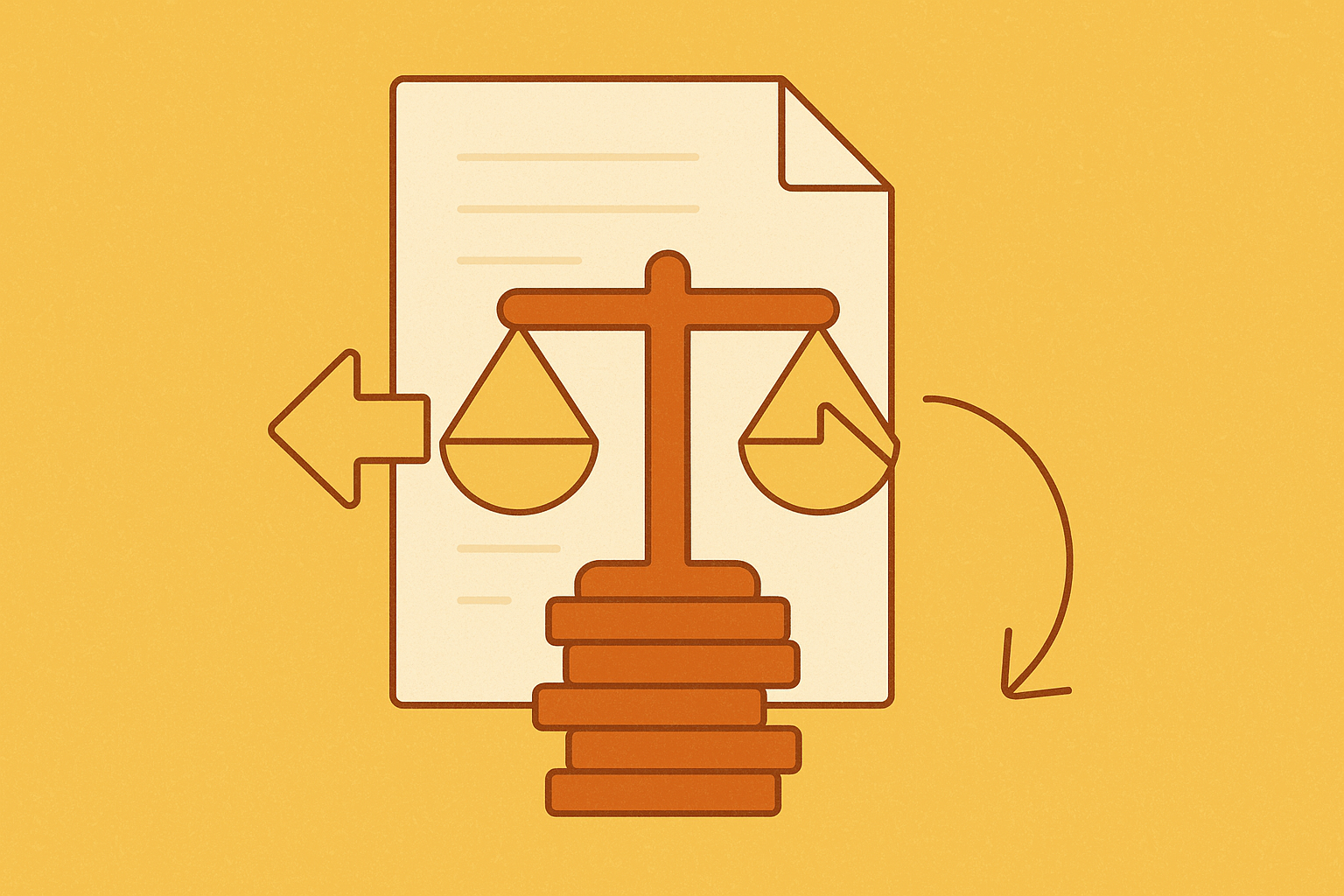
Decision debt is the accumulated cost of choices an organization never quite makes, never writes down, or never assigns to anyone in particular. Its most expensive form is the decision that got made, then quietly reversed, with no trace of either event.
Debt like this takes three shapes, and each compounds on its own schedule. Unmade decisions dress themselves up as caution while they block everything downstream. Unrecorded decisions get settled in a meeting or a Slack thread, then vanish from institutional memory, so the organization has effectively scheduled itself to make the same call again later. Unowned decisions happen by default, or by whoever spoke last and loudest, so the organization commits to something without anyone quite realizing it committed to anything.
The distinction that actually matters is between the moment of choosing and the record of it. The moment serves the people in the room. The record serves everyone else, indefinitely, and skipping it costs the organization precisely because of that asymmetry: a team that skips the artifact doesn't lack decisions, it lacks decision records. Debt builds structurally whenever there's no designed system for who gets to decide what, whenever consensus-seeking turns into indefinite deferral, and whenever outcomes get logged while the reasoning behind them doesn't. Decision logic ends up scattered across spreadsheets, system configs, one person's judgment, and code nobody remembers writing, until the organization can no longer see its own logic, let alone explain or improve it.
None of this is slowing down. McKinsey's State of AI report found 88% of organizations using AI in at least one business function, up from 78% the year before. AI raises the speed at which decisions get made and reversed, but it does nothing on its own to fix how they're recorded or governed. Treating AI adoption as a decision-governance fix on its own is a mistake most organizations are already making, and faster decisions without better records just means the debt piles up faster than it used to.
An unrecorded decision is a problem. An unrecorded reversal of that decision is worse, because it stacks a second invisible state on top of a first one. Nobody can point to what the original decision was, nobody can confirm it changed, nobody can explain why it changed, and nobody knows who had the authority to change it in the first place.
The compounding runs on a specific mechanism. People keep acting on the old decision because nobody told them it moved. The people who did hear about the change, usually secondhand, can't explain or defend it when someone asks. And the reversal itself becomes a live question all over again: is the current state intentional, or is it drift? Teams stop trusting their own records, because they genuinely can't tell anymore which one is true.
Reversals are harder to trace than the original decisions they overturn, mostly because they rarely leave any artifact at all, even when the initial decision did. A Confluence page gets edited with no version history. A Slack message supersedes a document that nobody bothers to link back to. The ASA blog documented a case that captures the shape of this well: two hours spent digging through a Slack thread, reviewing a calendar invite with no notes attached, and piecing together a half-written Confluence page, all to reconstruct a brief conversation from the previous quarter. That example involved a decision that had never actually been reversed. A reversal adds an entire additional layer of excavation on top of that, because now there are two states to reconstruct instead of one.
Scaling is about to make this considerably worse. Gartner projects that the average Fortune 500 company will be managing roughly 150,000 AI agents by 2028, up from fewer than 15 in 2025. At that volume, an undocumented reversal doesn't stay contained to the team that made it. It propagates through every downstream agent and workflow still acting on a state that, on paper, no longer exists.
How teams experience the cost, the symptoms that show up before anyone names the cause
Relitigation is usually the first sign, and it's the easiest to miss because it looks like normal process. The same choice gets paid for repeatedly, each time at full price. The sprint planning argument resurfaces every cycle, the architecture debate never seems to stay settled, and the recurring "alignment" meeting exists solely to re-converge on something the team already converged on months ago.
Zombie decisions are the second symptom, and they're worse than relitigation because nobody notices them as a pattern. A decision gets made, then made again next quarter, then made again after the reorg, because nothing ever pinned it down and no reversal was ever logged when the direction changed. New hires make this worse without meaning to. Enterprise onboarding already takes six to twelve months to reach full productivity, according to Brandon Hall Group research, and undocumented reversals stretch that timeline further by corrupting the very decision history a new employee is trying to learn from. They either repeat questions the team answered a year ago, or they make local calls that quietly diverge from what was actually settled.
Divergent local answers spread the same way, and this is the pattern most likely to appear in front of a customer rather than in an internal review. Teams blocked by the same piece of ambiguity don't wait around for clarity, they invent their own interpretation and move on, and the organization only discovers the mismatch later, usually at integration, in front of a customer, or during an audit. Knowledge fragmentation drives all of it: context lives in people's heads and scattered systems, so every request for background turns into archaeology, resting on whichever senior employee happens to remember how things really went.
Most organizations track time-to-market religiously and largely ignore time-to-decision. That's the wrong priority, given that the cost appears in daily work when a routine decision takes weeks that should take hours: that drag slows every downstream step, and no dashboard tracks it. It multiplies quietly, too. Every time someone has to re-explain a decision, in a one-on-one, in a Slack thread, in a planning meeting, that is the cost of the original undocumented choice, billed again.
The meeting as the unrecorded change point where reversals happen most often
Almost every organizational reversal happens in conversation: in a meeting, a call, or a working session, at the moment someone says "actually, we're going a different direction." It's rarely the scheduled agenda item. It appears in an aside, a correction mid-discussion, or a conclusion reached at the tail end of a conversation about something unrelated.
Meetings have a structural artifact problem baked in. The event itself serves whoever is in the room. Everyone else has to depend on notes, and those notes are often missing, incomplete, or reconstructed from memory well after the fact. A few patterns recur constantly: a decision gets revisited and changed in a one-on-one, and the update never reaches the wider team. A working session ends with a new direction, but the notes only capture the resulting action items, not the decision that produced them. Or a previous call gets overturned in a meeting where the person who made the original decision isn't even present, so the reversal is common knowledge to four people and a mystery to everyone else.
Even when notes exist, they usually record the outcome, "we're doing X," without recording the reasoning behind it, "because Y constraint changed." So the next time context shifts, nobody can defend the decision. They can only reopen it, which is functionally the same as never having made it. This connects to a governance failure the European Business Review has pointed to in its analysis of AI decision debt: teams build and deploy before they've agreed on risk thresholds, approval requirements, escalation paths, documentation standards, or which decisions AI is even allowed to make on its own. Every policy bolted on afterward adds to the debt instead of resolving it.
What AI meeting tools capture, and what most still miss about decisions
AI meeting tools generally produce a verbatim transcript, a one-page summary, and a list of action items with owners and deadlines attached. The pipeline runs from automatic speech recognition, turning raw audio into text, through a language model that structures, summarizes, and extracts the pieces worth keeping.
Two architectures dominate how the audio actually gets captured, and the choice between them isn't cosmetic. Bot-based tools join the call as a visible participant, pulling audio through the meeting platform's API, so everyone on the call can see it's there. Device-level tools listen through the device's own microphone and speakers, with no bot in the participant list at all, silent and local to the machine. Which one belongs in which room is a governance question, not a feature preference.
The better tools go past plain transcription and flag key moments, highlight decisions, and surface action items, so a team gets a record it will actually use instead of a wall of text nobody rereads. The real gap, the one that matters for decision debt specifically, is that most tools are built to capture what was said and who owns what action. Far fewer reliably capture that a prior decision got reversed, what it was reversed from, or why. Catching a reversal requires the tool to recognize it as its own category of event, not an action item but a state change that overwrites something that came before it. That's a harder problem than transcription, and most tools on the market haven't solved it yet, and treating reversal detection as a solved problem is the mistake buyers keep making.
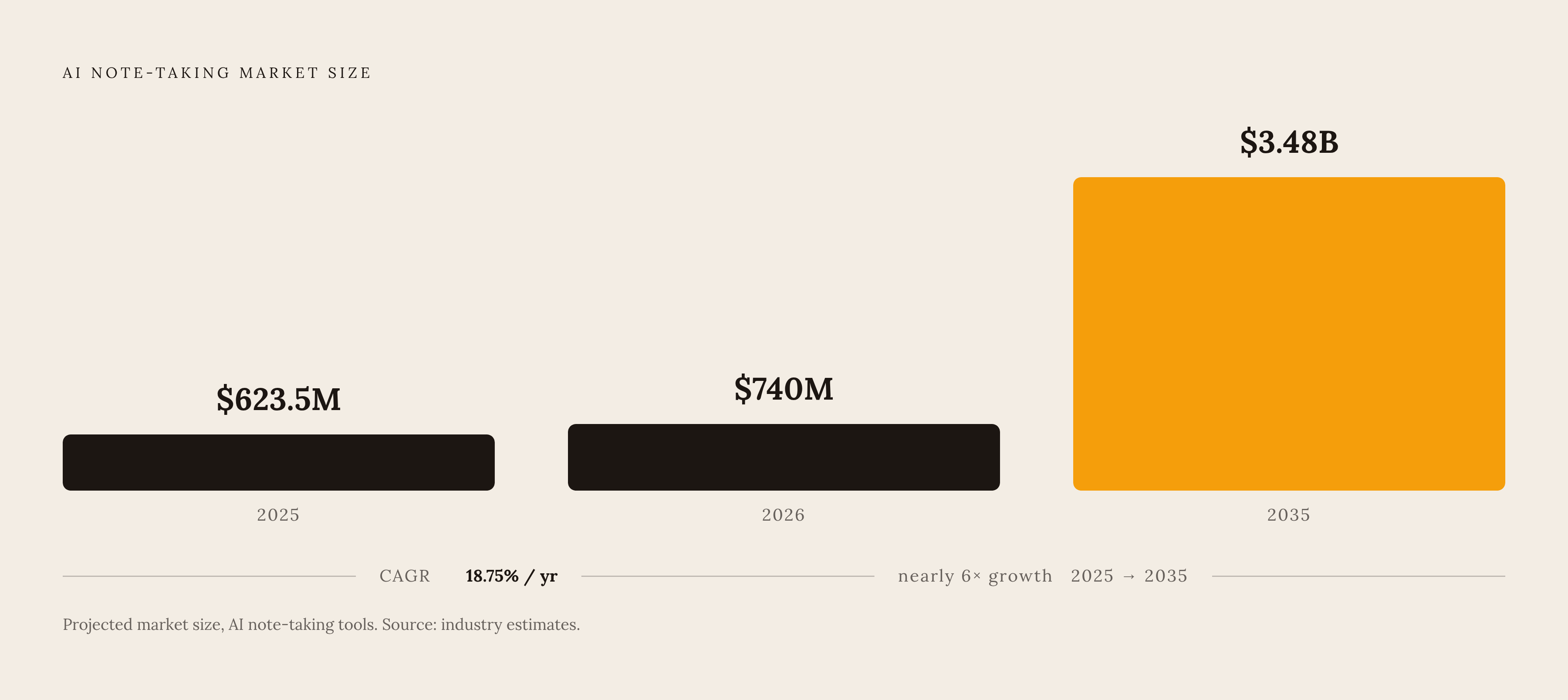
The market is growing fast enough that this gap won't stay hidden for long. AI note-taking was a $623.5 million market in 2025, crossed $740 million in 2026, and is on track toward roughly $3.48 billion by 2035 at an 18.75% compound annual growth rate, according to industry market research. The tools are multiplying faster than the organizational habits around using them for anything resembling decision governance, and that mismatch is exactly where the debt keeps accumulating. Some conversations shouldn't run through AI at all: legally privileged discussions, board minutes, and meetings under strict consent rules still need a human record as the authoritative one.
Workflow automation turning a captured reversal into an updated record across the tools that act on it
A reversal captured perfectly in a meeting note that then sits in an isolated folder produces the exact same organizational outcome as no note at all. Nobody acting on the old decision ever learns it changed, because the record and the people who need it never actually meet.
This is where post-meeting automation earns its keep. It can push a decision summary into the relevant Slack channel, update the CRM field that reflects the newly agreed approach, or spin up a task in a tool like Linear or Asana that formally closes the old direction and opens the new one. The routing logic has to be built for reversals specifically, distinct from generic updates: the automation needs to know which prior decision is being overwritten, not just what the new one says. Tagging something as a reversal, rather than a fresh action item, is what gets it to actually reach the people still operating under the old assumption.
A CRM scenario makes this concrete. A deal's approach shifts mid-cycle during a call. Without automation, the rep updates the record manually, or more often, doesn't. With it, the decision extracted from the meeting note triggers a field update and routes a follow-up task to the right owner automatically. The more advanced setups don't wait to be asked. They surface the original rationale and any logged reversal the moment the same decision territory comes up again, before someone has to go digging for it.
The State of Sales Technology 2025 report found 82% of respondents already using AI to boost productivity and work more efficiently. The infrastructure to route meeting intelligence into the tools that act on it largely exists already. What's missing isn't the plumbing; it's the practice of routing decision state changes, reversals especially, through that same infrastructure.
What a reliable decision record actually contains, and how to build the habit around meetings
A decision record, at minimum, needs five things: what was decided, who decided it, when, on what reasoning, and, critically for reversals, what prior decision it replaces. Most decision logs, where they exist at all, stop well short of that last field. That last field is the one doing all the work.
Reversals need their own fields specifically: what the prior decision was, when it was made and by whom, what changed in the constraints or information that drove the reversal, and who needs to be told because they're still acting on the old state. Sorting decisions by reversibility before sorting them by importance helps here too. Reversible decisions are cheap to make and cheap to undo, but only if the reversal actually gets recorded. Unrecorded reversals of otherwise-reversible decisions are the single most common source of zombie decisions, which is reason enough to treat the reversal log as more urgent than the decision log itself.
Where the record lives matters as much as what's in it. A decision log sitting outside the tools people actually work in is a log nobody opens. The record has to live where the next person who needs it will naturally look, in a system whose existence they don't have to remember on their own. And the capture has to happen at the meeting itself, in the moment the decision or the reversal actually occurs, because that's the only window where the reasoning is still fresh enough to write down accurately. Reconstructing it later is the two-hour Slack excavation all over again.
AI meeting tools that extract decisions and flag reversals as they happen cut the friction on all of this considerably. The raw material is already sitting in the note. The workflow routes it. The log populates itself without anyone doing extra manual work. But none of it functions without decision rights defined ahead of time: knowing who's allowed to make a reversal, and who has to be told when one happens, is what tells the automation where to send it. The structural fix and the tooling fix need each other. Neither works alone, and organizations that buy the tooling while skipping the structural fix are the ones still stuck relitigating the same decision three quarters later.
Choosing an AI meeting tool that supports decision capture, not just note-taking
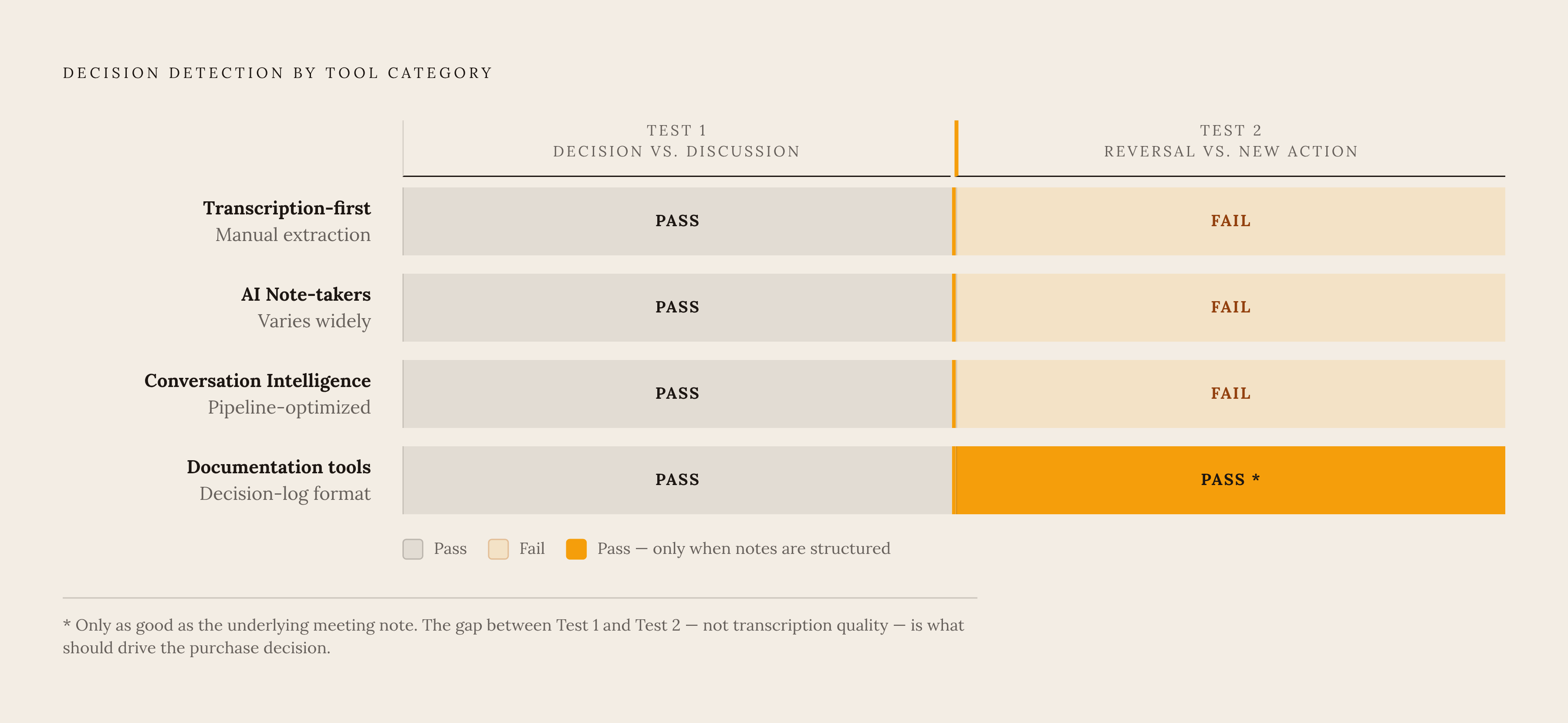
Most AI meeting tools are built for note-taking and action-item extraction. The question that matters for decision debt is narrower: can the tool tell a decision apart from a general discussion point, and can it tell a reversal apart from a brand-new action item? Most tools on the market today fail the second test even when they pass the first, and that gap, not transcription quality, is what should decide the purchase.
Four categories cover most of the market, and each handles this differently. Transcription-first tools offer the highest fidelity to what was actually said but the weakest structured decision extraction, useful when an exact record is needed to defend a choice later, though the decision layer still has to be pulled out by hand. AI summary note-takers make up the largest category, and they vary widely in whether decisions appear in a distinct, labeled, searchable field or just get folded into a paragraph of general summary, so check this directly before committing to one. Conversation intelligence and sales tools tend to be strongest on CRM routing and deal-signal extraction, with pipeline automation already built in, making them the better fit where the reversals that matter most happen in customer-facing calls. Documentation tools turn meeting output into structured internal docs and come closest to a true decision-log format, though they're only as good as the underlying meeting note they're built from.
Integration depth ends up deciding more than most people expect going in. A tool that catches a reversal beautifully but can't push it into Slack, the CRM, or whatever project tool the old decision lives in has only solved half the problem. Integration depth should outweigh transcription polish in any real evaluation. Check specific integrations against the specific handoffs a team actually relies on day to day.
Choosing between visible bots and silent device-level capture isn't really an either-or, whatever the vendor pitch implies. Visible bots make sense for external calls where consent is clear and sales conversations that need direct CRM routing. Silent device-level capture fits better for internal working sessions, in-person discussions, and anything more sensitive. Most teams end up needing both, and knowing which mode applies where matters more than picking a single default and forcing every meeting through it.
Privacy and retention deserve a real audit before anything gets signed, addressed from the outset rather than folded in once the tool's already embedded. Decision records carry sensitive strategic context by definition, so who controls the data, whether raw audio gets retained, and what the deletion and access policies actually say need answers up front. Before committing to any tool, confirm whether it labels decisions separately from action items and general notes, whether past meetings are searchable by decision or topic, and whether it can push decision summaries directly into the tools where the affected work is actually happening.