How Fast Do Professionals Forget What Was Decided in Meetings
Most professionals forget 60% of meeting decisions within an hour.
What Ebbinghaus established and later research refined
Professionals forget meeting decisions faster than they realize, and that drop-off isn't vague or anecdotal. It follows a measurable curve, one that plays out in hours rather than days, and most teams reinforce decisions long after the brain has already let them go. The standard follow-up habits built around meetings are aimed at the wrong moment.
Hermann Ebbinghaus ran the original experiments on forgetting in 1885. The figure that survived into common use holds that people lose roughly 66% of new information within 24 hours if nothing intervenes, with estimates ranging from 50% to 70% depending on the material and the testing method. That range is the baseline everything else here gets measured against, and it was never meant to be a fixed law of memory. Treating it as one is the first mistake most retention advice makes.
Later work went back and found something messier. Work-Learning Research reviewed 69 conditions across more than a thousand learners and found forgetting ranging from 0% to 94%, depending on what was being remembered and how it was tested. Even inside a tight one- to two-day window, the spread ran from 0% to 73%. Frank Bahrick's 1979 word-pair study found forgetting between 12% and 63%, and once measurement artifacts got folded in, the swing widened past a hundred percentage points.
So "70% in 24 hours" works fine as a benchmark. What holds steady across the research is the shape, not the number: forgetting starts fast and levels off afterward. Where a given person actually lands depends on the strength of the learning method, how much prior context they carried in, how motivated they were to retain it, and whether they engaged in retrieval practice, actively recalling the information, rather than just hearing it once and moving on.
That last variable is the one meetings fail on almost by design. Passive listening, the default mode of most meeting participation, resembles the low-utility study techniques a 2013 review of learning methods flagged as weak: rereading, highlighting, passive review. The brain treats a passive meeting the way it treats background noise. It doesn't spend resources encoding something it was never asked to retrieve.
The forgetting curve's mapping onto the hours after a meeting ends
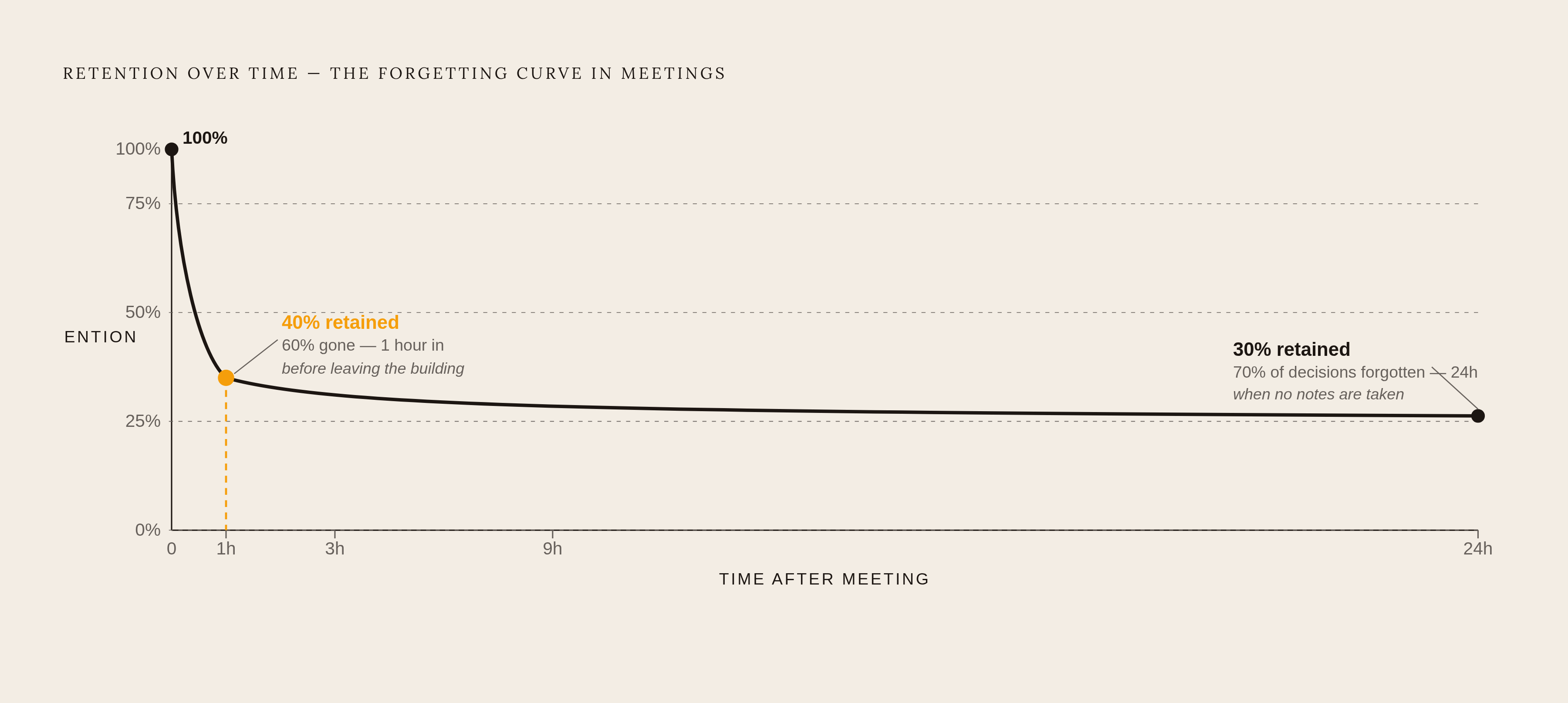
Apply that curve to an actual meeting and the numbers turn uncomfortable fast. Data from Laxis puts the figure at 70% of meeting decisions forgotten within 24 hours when no notes get taken, which tracks Ebbinghaus almost exactly. A century-old lab finding still predicts what happens in a Tuesday afternoon status call, and that alone should unsettle anyone who assumes memory at work behaves differently than memory anywhere else.
The steeper number is the one-hour mark. Research cited in Education Canada, discussed by educator Jordan Tinney, points to people forgetting up to 60% of learned material within an hour of encountering it. Run that math on a meeting and a participant can be down to roughly 40% retention before they've made it back to their desk.
Layer a failure to comprehend on top of the failure to remember, and the picture gets worse before forgetting even has a chance to start. Atlassian's research found that 54% of employees often leave meetings without a clear idea of what the next steps are, and that isn't a memory failure at all: the information was never encoded clearly in the first place. Wundamail's data backs this from the behavioral side, finding that 30% of participants fail to complete actions they agreed to in a meeting, tracing that directly to an inability to recall the key details afterward.
Multitasking explains why encoding starts weak in the first place. With 73% of professionals reportedly multitasking during meetings, shallow encoding is the norm. A decision made at 10am is measurably at risk by 11am, and by the next morning, for most people, it's largely gone. Not eventually, and not for some unlucky subset of distracted employees. It happens as a predictable cognitive pattern, meeting after meeting, to nearly everyone in the room.
The scale of meetings that feed this forgetting pipeline
None of this would matter much if meetings were rare. Meetings are far from rare, so this does matter. Employees now spend 11.8 hours a week in meetings, nearly a third of a standard workweek, and meeting volume has climbed roughly 10% annually for two straight decades according to BOOQED data, a slow grind that the rise of hybrid and remote work further accelerated.
The daily density is where the problem turns structural instead of merely inconvenient. Forty-six percent of professionals sit in three or more meetings a day, and half of all salespeople spend more than five hours a day in meetings specifically. Enterprise employees carry the heaviest load: 59% log more than five hours a week in meetings, against 32% at smaller companies, a gap that likely reflects the extra coordination layers larger organizations stack on top of everything else.
Timing makes the cost worse, not better. Research shows about half of all meetings cluster between 9 and 11 in the morning or 1 to 3 in the afternoon, the exact windows when most people do their sharpest individual work. Meeting content competes directly with focused work for the same limited encoding resources, and it frequently loses. Add that 57% of meetings are ad-hoc, with no calendar plan and no retrieval scaffolding built in beforehand, and the pipeline runs on default: more hours, more meetings, stacked into peak cognitive periods, with nothing systematic supporting the act of remembering any of it.
What this forgetting costs organizations in measurable terms
Thirty-five percent of meetings get flagged as a waste of time, and many senior leaders describe meetings overall as unproductive. Those complaints come from the people running the meetings, not outside critics, which makes them harder to wave off. The dollar figure attached is blunt: meeting time costs an average of $29,000 per employee per year, before counting the hours spent just scheduling around everyone's calendars.
The follow-through gap compounds the memory loss rather than sitting beside it. Laxis found that 40% of meetings rated "least productive" lacked clear follow-ups or action items entirely, so cognitive loss stacks on top of a process failure that happens regardless of what anyone remembers. Asana's 2024 research names the resulting fog "meeting hangover," and found workers often spend post-meeting time on anything but follow-through: a secondary drain no calendar audit ever captures.
Forgotten decisions don't disappear quietly. They resurface. A decision that was never properly captured tends to reappear as an agenda item the following week, and the same ground gets covered again, sometimes twice. Wundamail's numbers put a figure on the disengagement feeding this cycle: 42% of video call participants dial in and contribute nothing at all. That's meeting investment, hours, salaries, calendar space, producing no encoding and therefore no usable output, at scale, on a recurring basis.
The capture window's narrowness relative to what most follow-up practices assume
Memory research is directional about timing, and the direction is unambiguous: reinforcement works best during the steep early phase of the forgetting curve. Waiting until the next morning to send a recap means waiting until after most of the damage is already done, and most standard follow-up practice gets this exactly backwards.
Practitioner guidance points to acting quickly after a meeting ends, with reinforcement timed to land before the curve bottoms out. Jordan Tinney cites a CBC segment built around the 90-second principle: spending just 90 seconds at the close of a meeting to restate action items and name owners measurably improves what participants go on to do. Ninety seconds of structured recall against hours of otherwise-wasted retention isn't a close call, and treating it as optional is where most meeting hygiene fails.
Most teams are living inside an irony without noticing it. With 54% of employees leaving meetings unclear on next steps, the standard fix, an email recap sent hours later, or notes dropped into a shared drive nobody reopens, arrives well after the critical window has shut. Spaced repetition research remains among the most validated methods for building long-term retention: reviewing material at gradually widening intervals rather than once and never again. Spacing only works if there's something solid to space against, though, and without a reliable first capture, there's nothing left to repeat.
The bottleneck was always timing and capture reliability. Fixing how a team follows up without fixing how fast and how reliably decisions get captured in the first place means optimizing the wrong part of the system, and most retention advice never gets past that mistake.
What AI meeting tools do to interrupt the forgetting curve
AI meeting tools combine automatic speech recognition with large language models, converting spoken discussion into structured text in real time or within moments of the meeting ending. That single mechanical shift moves the first capture point to somewhere useful on the forgetting curve: instead of landing hours later, once most of the information has already faded, capture happens inside the critical window, before the steepest part of the drop-off plays out.
Transcription is just the raw material, though, and treating it as the finished product is where a lot of teams stop too early. The more useful layer is what the models do with it afterward: generating summaries, pulling out decisions, flagging action items, producing a structured artifact that can be reviewed and acted on without anyone holding it in working memory. The artifact does the remembering so the person doesn't have to.
Accuracy has a ceiling. Modern tools reach strong accuracy under good conditions: clear audio, English speech, minimal cross-talk. Performance drops with background noise, overlapping speakers, or non-English content. At this point accuracy functions as table stakes, not a differentiator. Every credible tool in the category has to clear that bar just to be usable, and asking how accurate any of them is no longer tells you anything interesting.
Adoption reflects how normalized this has become. AI note-takers have seen broad adoption, with a large share of professionals now using one in meetings. But most of these tools stop at the meeting room door: they capture and summarize, and the artifact just sits there afterward. The real differentiator is what happens to that content next, how well it fits into existing workflows, how deep the integrations run, and whether the decision actually moves to where the work happens. A visible bot joining a call changes how people behave during the meeting itself; browser-extension or desktop capture runs invisibly instead. Neither is universally better. They produce different meetings, and the choice between them should depend on what a team is actually optimizing for.
Routing captured decisions into existing workflows to close the forgetting loop
Seventy-five percent adoption of AI note-takers sounds like the forgetting problem is basically solved. It isn't, and the reason is structural, not incidental: most of these tools still stop at the meeting room. The decision gets captured accurately, summarized well, and then goes nowhere. It sits in a transcript nobody reopens, a more sophisticated version of the same shared-drive problem teams have had for years, just with better formatting.
This is most visible in the sales-to-delivery handoff. Customer context gathered carefully during a sales call gets lost somewhere between that call and the CRM entry, and the delivery team ends up reconstructing what the customer actually wants from memory and secondhand notes. That's a documented failure point, and a direct, costly consequence of capture without routing, not some separate problem layered on top.
Routing is the fix, and it's a mechanical one, not a cultural one. Pushing meeting decisions directly into CRMs like HubSpot, Salesforce, or Attio, into project tools like Linear or Asana, and into communication platforms like Slack means the captured content lands inside systems people already check every day. No new tool to learn, no separate place to remember to look. A task auto-assigned inside the tool where the work actually happens benefits most from this, since it isn't subject to the forgetting curve the way a mental note or a buried line in an email recap is. The artifact persists on its own and prompts the person again later, without asking memory to do any of the work.
The direction here is agentic rather than archival. Instead of waiting for someone to ask what got decided, the system delivers the relevant decision at the moment it's needed inside a downstream workflow, and that reframes what a meeting actually is. Meetings are among the richest, and most wasted, sources of organizational context a company generates. A decision that gets captured, routed, and made retrievable becomes part of institutional memory. A decision that doesn't just becomes next week's agenda item again, and the cycle resets, exactly as it did the week before.