Transactive Memory Breakdown in Growing Teams
Small teams lose shared memory naturally as they grow beyond what conversation alone can sustain.
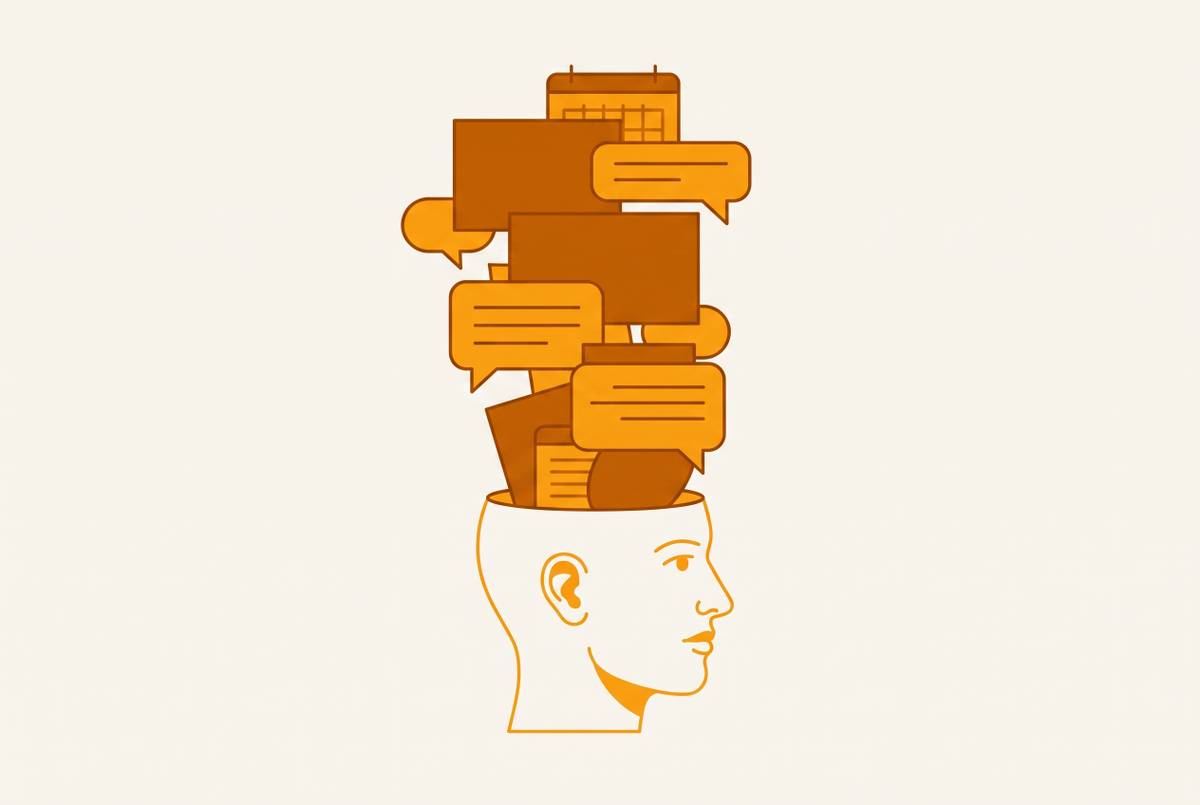
Transactive memory systems are the reason a five-person team doesn't need a wiki to function. Everyone just knows that Maya handles the API and Jordan owns the customer relationship, and that knowledge stays current without anyone writing it down. Growth is what kills it, and almost nobody notices the exact moment it happens. Duplicated work piles up, decisions get re-litigated in meetings where half the room forgot they were already settled, and knowledge walks out the door with whoever happens to leave. Most teams respond by buying a wiki or a knowledge base, and that response is wrong on its face: the knowledge was never sitting still long enough to be filed. It moved through conversation, and conversation is what most teams still fail to capture.
The term comes from a psychologist who described transactive memory systems, or TMS, as the shared cognitive division of labor by which a group encodes, stores, and retrieves knowledge collectively rather than individually. No single person holds the whole picture. Instead, the group holds a map of who holds which piece, and that map becomes a kind of memory in its own right. Researchers generally break TMS into three dimensions: specialization (who knows what, and whether the group knows that they know it), credibility (whether people trust each other's expertise enough to rely on it), and coordination (whether the group can act on that knowledge without friction). In a small team, all three dimensions run on autopilot, since people learn each other's domains by sitting near each other, by repeated conversation, by watching each other work. Nobody schedules a meeting to establish that Jordan is the one to ask about the customer. It just becomes obvious.
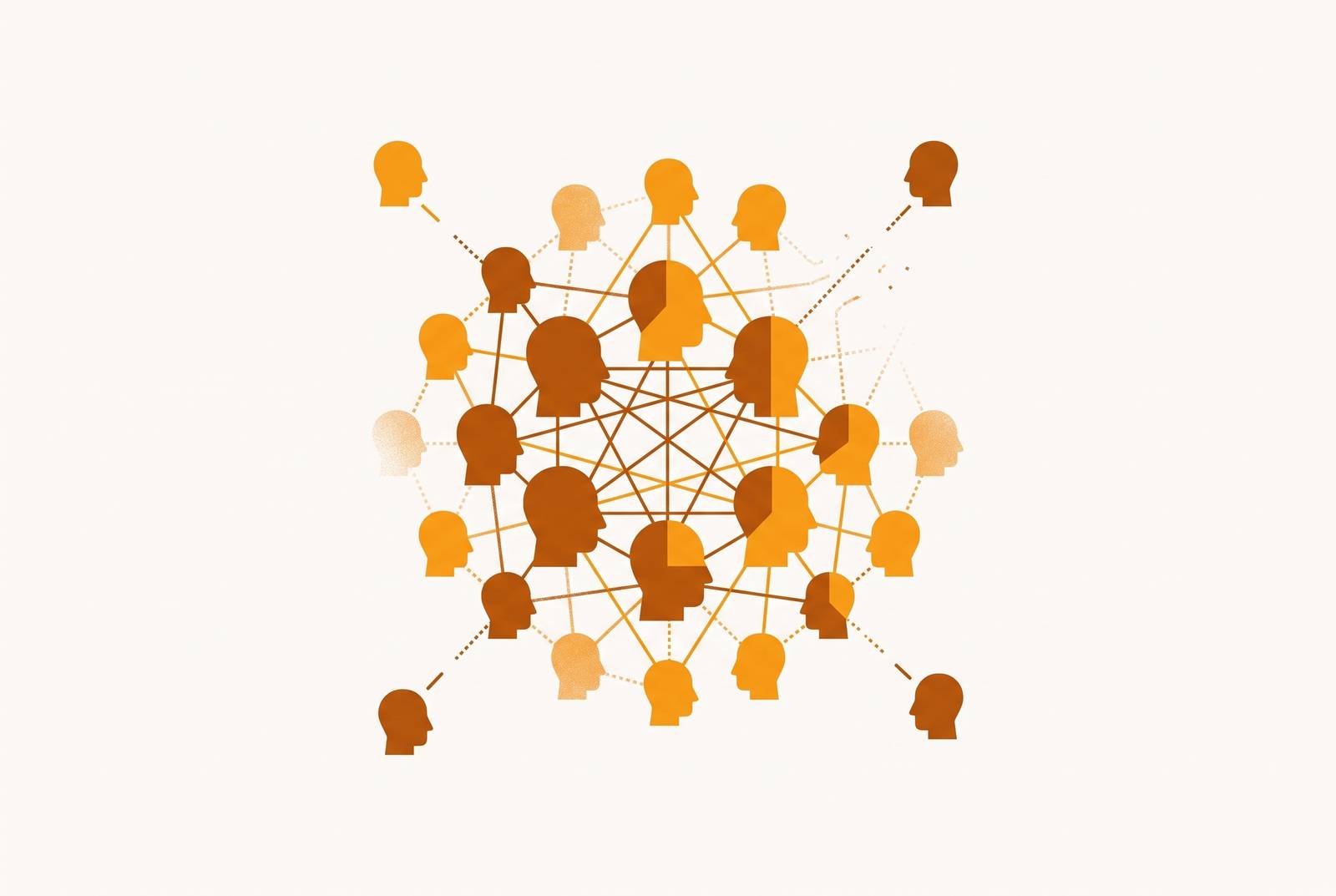
The failure is structural, and that distinction matters more than most teams give it credit for. A cognitive map that five people maintain effortlessly in their heads becomes mathematically unmanageable at fifty, because the number of relationships to track grows far faster than the number of people does.
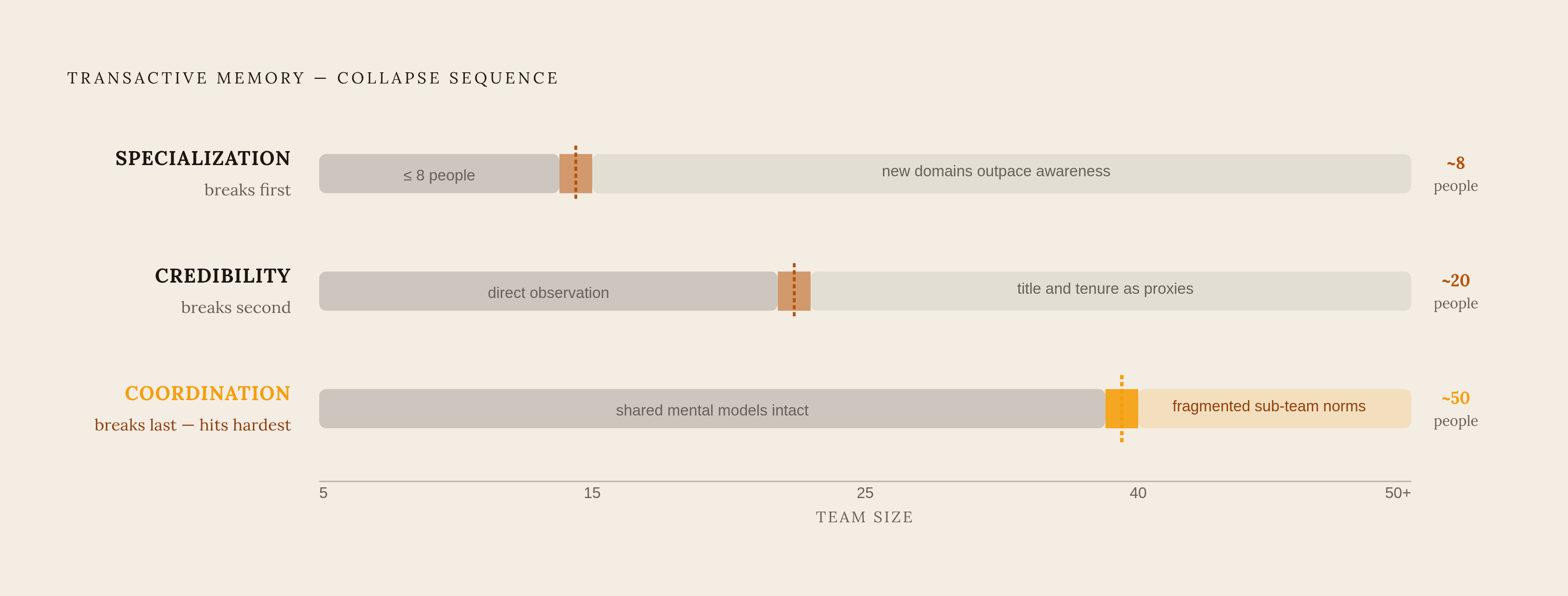
Each of the three TMS dimensions breaks in its own way, and specialization goes first. New domains and sub-specialties appear faster than awareness of them can spread, so people default to asking whoever they already happen to know, even once that person is no longer the best source. Credibility breaks next, and more quietly. Trust in someone's expertise is supposed to come from watching them perform, but in a fifty- or hundred-person team, most colleagues have never actually seen each other work, so credibility defaults to proxies instead: job title, tenure, how senior someone sounds in a meeting. Everyone using those proxies knows they're a worse signal than direct observation, but there's rarely an alternative once direct observation is off the table. Coordination breaks last, and it hits hardest, because smooth handoffs depend on shared mental models of how work gets done, and those models fragment the moment sub-teams start building their own local norms and workarounds.
Research on organizational routines backs this up directly. A 2026 study in Industrial and Corporate Change by Kost, Hærem, and Pentland found that organizational routines mediate the relationship between TMS and team performance: routines, not individual memory, carry a transactive memory system once a team outgrows informal maintenance. Growing teams are usually still building those routines while already needing them, and that gap is where institutional knowledge falls straight through.
That gap has a recognizable shape. A senior engineer leaves, and the reasoning behind a technical decision made eighteen months earlier leaves with them, because nobody wrote it down anywhere a successor could find it. A product manager moves to a different team, and the fact that a similar feature already failed for a specific, well-understood reason never transfers, so someone builds it again, and it fails for the same reason, across teams that never talk to each other. A consultant finishes an engagement, and the client keeps the deliverable but not the reasoning that produced it, so the deliverable becomes something to defend rather than something to build on.
Where TMS lives in meetings, and where it most often goes unrecorded
Meetings are where transactive memory actually gets exercised. Someone asks a question, and the room defers to whoever answers it. Someone corrects a misconception, and that correction updates, in real time, who the group trusts on that topic. A decision gets made in front of witnesses who can later attest to why. Every meeting is, in effect, a live update to the team's shared map of who knows what and who is worth believing on which subject.
Almost none of that update gets kept, and the reason has nothing to do with laziness. Professionals spend a substantial share of their working hours in meetings, and studies on meeting recall consistently find that participants forget roughly half of what was discussed within a day. Information that only ever existed as spoken words in a room sits briefly in working memory, then gets displaced by the next meeting, the next conversation, the next task. It happens regardless of attention or diligence, and no amount of good note-taking habit fixes it at scale.
Decisions disappear. Commitments disappear. The reasoning that made a decision defensible disappears, even when the bare conclusion survives in someone's memory. None of that is a discipline problem. It is what happens to a transactive memory system that was never given anywhere to live outside the room it was built in.
What it means to externalize a transactive memory system
Externalizing a TMS means more than writing things down, and treating it as a note-taking problem is the mistake that sinks most attempts at it. A transcript alone doesn't do it. Neither does a set of bullet-point notes from whoever happened to be typing during the call. Real externalization requires three distinct things at once: what was actually said, who said it and in what capacity (the domain expert speaking, versus someone thinking out loud), and what got decided or committed to as a result. If any one of those three is missed, the record looks complete while it quietly answers the wrong question later.
Done well, this produces something closer to organizational memory: a structured, persistent knowledge layer that lets a company retain, connect, and apply what its people collectively know, across every team and tool and workflow, rather than a folder of files nobody revisits. It's a living record, updated continuously as the organization keeps operating, not a snapshot taken once and left to go stale.
Two shifts point toward where this is heading. Knowledge graphs are starting to replace folder structures, so the system maintains its own map of how ideas, people, and decisions connect, instead of relying on a human to decide where a document belongs and how to tag it. And tools are moving from reactive search toward proactive surfacing, pushing relevant context to someone before they think to search for it, inside the document they're drafting or the email they're replying to or the meeting they're walking into. Together, these describe a system where a new hire gets the context behind a decision, not just access to the document it produced, where a team can confirm who actually committed to what without relying on someone's memory of the call, and where the reasoning behind a choice made months ago can be recovered without tracking down the person who made it.
How AI meeting tools capture what human memory cannot hold
AI meeting tools address knowledge loss at the point where the knowledge gets generated: the meeting itself. The mechanism is straightforward. The tool records the conversation, transcribes it with speaker identification attached to each line, then generates a structured summary that pulls out decisions, action items, and topics, all without requiring anyone in the room to take notes.
Under the hood, this runs on generative AI paired with natural language processing for transcription and summarization, with large language models doing the work of pulling commitments and decisions out of what is otherwise an unstructured wall of text. The output that matters for TMS purposes is the structured layer built on top of the transcript: who said what, who now owns which action item, and what got decided along with the stated grounds for deciding it that way.
Transcription accuracy is close to commoditized at this point among the leading tools, at least in English, and that is no longer where meaningful differentiation happens. What separates a tool that actually helps a growing team from one that just generates noise is what happens to that accurate transcript after the meeting ends. That is a question of routing, not recording, and it is the question most teams evaluate last instead of first, which is exactly backwards.
Why captured meeting intelligence only works if it reaches the rest of the team's tools
A meeting summary sitting inside a meeting tool's own dashboard is close to worthless if nobody on the team ever opens that dashboard. Integration is not a nice-to-have feature bolted onto a good transcript. Whether captured knowledge gets used at all depends on it. Action items, decisions, and commitments that don't flow into the calendar, the CRM, and the project management tool a team already lives in get ignored, no matter how accurate the underlying transcript was.
Done well, routing looks specific. Action items get assigned to named owners and written directly into tools like Asana or Linear, so they show up where the work already happens rather than in a separate app nobody checks. Sales call summaries, along with any commitments made on the call, sync straight into CRM records in HubSpot, Salesforce, or Attio, cutting out the manual data entry that otherwise gets delayed, half-finished, or skipped. Decision records land in Notion or Slack, so the people who weren't in the room get the reasoning behind a call, not just the headline outcome.
The choice of native integration over a stitched-together one decides whether the system survives contact with reality, and that choice is not a minor implementation detail the way vendors like to present it. A Zapier connection stitching two platforms together requires ongoing upkeep and tends to break whenever either platform changes its API, which happens often enough to matter. A native integration writes structured data directly into CRM objects and project records, and it holds up over time instead of quietly failing after some unrelated update six months later.
Consider the sales-to-customer-success handoff, a specific and common TMS failure. A prospect explains their goals and challenges on a sales call, the deal closes, and then the customer success team, on their first call with that same customer, asks the same questions all over again. That repetition is a direct symptom of a transactive memory system that never got externalized. The knowledge existed, briefly, in one person's head, and it never made it anywhere the next person could retrieve it. Meeting summaries that carry forward a customer's stated goals, challenges, and commitments close exactly that gap.
How meeting data becomes queryable organizational memory through MCP and AI assistants
Routing data into existing tools solves retrieval for humans who already know where to look. It does not solve the harder problem: asking an AI assistant a genuine question, like what got decided about a specific issue in last Tuesday's call, and getting a real answer pulled from the actual archive of meetings instead of a plausible-sounding guess.
Before the Model Context Protocol existed, connecting a meeting archive to every AI assistant a team might use required a custom integration for each pairing, a many-to-many problem that made broad access impractical past a small number of tools. MCP, an open protocol published by Anthropic in November 2024, gives LLMs a standardized way to connect to external data sources, so a meeting archive can expose itself once and get queried by any compliant assistant, rather than needing a bespoke connector built for each one. OpenAI's adoption of the protocol in March 2025 pushed it toward becoming the de facto standard across vendors, rather than one company's approach competing against several others.
MCP defines a set of primitives that allow AI assistants to connect to external data sources in a standardized way. Meeting transcripts and summaries fit naturally into that model, exposable once so any compliant AI assistant can query them directly rather than needing custom wiring built for every new integration.
In practice, that means an assistant can answer a question like what objections a given prospect has raised across every call they have had with the sales team, drawing on the full archive rather than one meeting at a time. Built this way, a meeting archive functions as organizational memory a team can actually converse with.
What growing teams should do to stop losing what they know
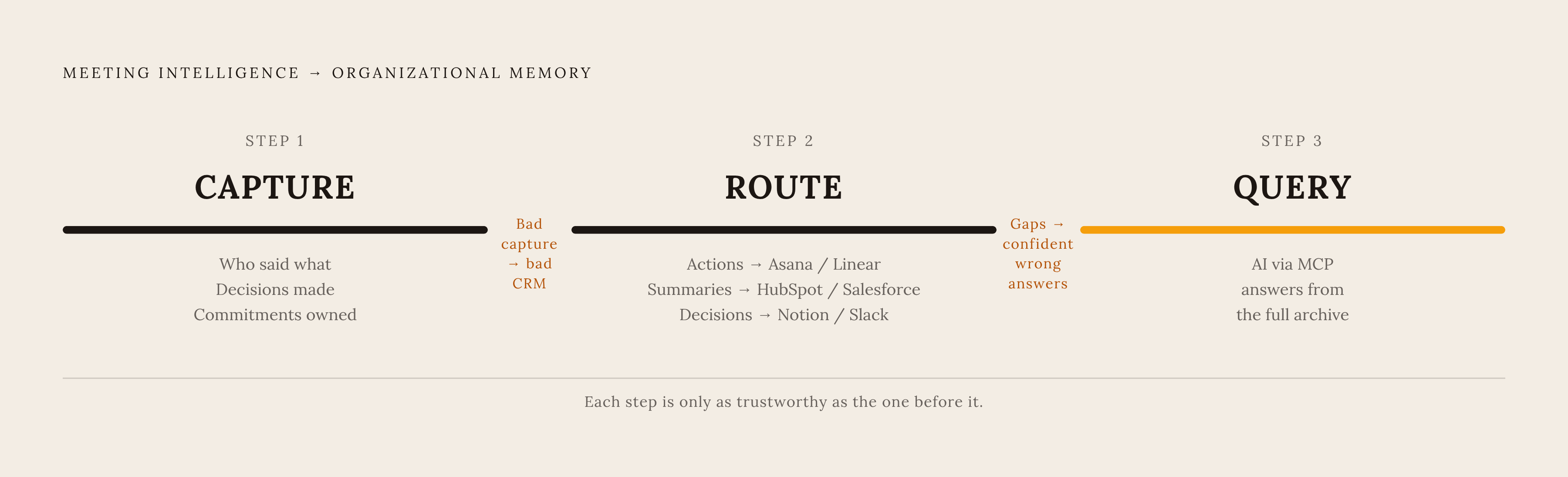
The sequence here is not optional, and skipping ahead in it produces a tool nobody trusts. Capturing meetings well has to come first, because routing bad or incomplete data into a CRM just gets a team a CRM full of bad data, faster than before. Routing has to come before querying, because an AI assistant answering questions from an archive that data never made it into is just guessing with extra steps. Skipping the capture and routing layer means the querying layer on top looks sophisticated but answers questions wrong, and a confident wrong answer does more damage than having no system.
Step one is treating meetings as the primary event where a team's transactive memory system gets maintained. Structured capture of who said what, what got decided, and who owns what is the only mechanism left for keeping the who-knows-what map current once headcount outpaces anyone's ability to hold that map in their own head.
Step two is choosing a tool whose outputs actually land somewhere useful. The evaluation should focus there, not on how good the summaries read on the page. Ask, concretely, where the action items and decisions physically end up once the call ends, and identify anyone besides the person who took the call who will ever see them.
A handful of criteria decide this in practice. Native integrations with the specific CRM, project tool, and communication platform a team already relies on matter more than a generic export function nobody opens. Speaker identification needs to be accurate enough to say with confidence who committed to what. Support for both bot-based and botless capture matters too, since not every meeting context tolerates a visible recording bot showing up uninvited. And search across the full history of past conversations counts for more than access to any single meeting record: one transcript is a document, but a searchable archive spanning every past call is the beginning of an actual memory.
Sources
- Transactive memory systems and team performance: the mediating role of routines | Industrial and Corporate Change | Oxford Academic
- Transactive Memory Systems in Organizations: Matching Tasks, Expertise, and People | Organization Science
- Organizational Transactive Memory Systems: Review and Extension: European Psychologist: Vol 17, No 1
- modelcontextprotocol.io