Why Written Meeting Notes Are Systematically Incomplete
The note-taker's brain cannot listen and write simultaneously, making incomplete records inevitable.
Meeting notes fail on a predictable schedule, and it has nothing to do with who's holding the pen. The person taking notes is trying to run two processes the brain cannot execute at the same time: participate and transcribe. That structural conflict, not carelessness, explains why the follow-up you needed is never quite where you left it. Atlassian research puts the average professional at 31 hours a month in meetings, and that number matters here because it's the scale at which this failure repeats: every week, across every team still relying on someone scribbling while everyone else talks.
The dual-task bottleneck: what the brain cannot do simultaneously
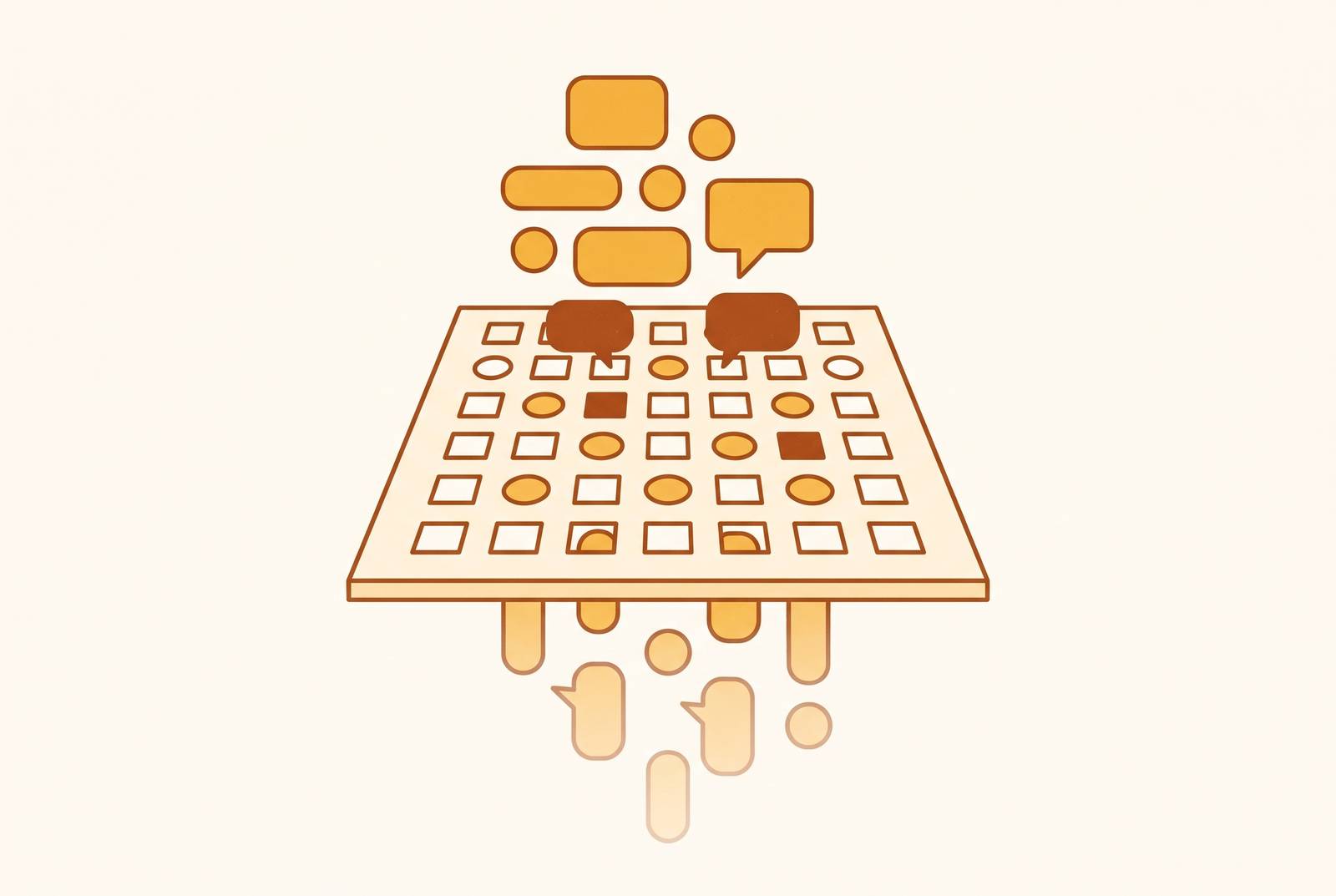
Someone in the room is always assigned, formally or by default, to be the secretary. That same person is also expected to weigh in, ask questions, and read the room. Those two roles compete for the same limited resource, and the competition isn't a metaphor: writing requires active cognitive engagement, a process that competes with the attention needed to listen and comprehend. The brain shifts between tasks rather than handling them simultaneously, and each shift comes at a cost.
What ends up on the page is whatever the note-taker found easy to write quickly, or personally interesting, not what the group actually decided. The switching itself creates blind spots that never register in real time. Because attention shifts to writing down one point while the next point is already being made, the gap between them may go unnoticed until someone asks about it weeks later.
Whoever happened to be holding the pen that day shapes the record, standing in for a record of what actually happened in the room. Those are not the same document, and treating them as interchangeable is where most meeting-note failures start.
Nonverbal and paralinguistic information lost before the pen hits the page
Meetings don't run on words alone. Tone, hesitation, a raised eyebrow, the pause before someone answers: all of it carries information that written notes are structurally incapable of holding onto. A notetaking system, human or otherwise, records language. It does not record the face someone made while saying it.
Take the stakeholder who says "sure, we can try that." Said flatly, arms crossed, eyes on the table, that sentence means reluctant compliance at best. Said with a nod and real enthusiasm, it means buy-in. The transcript reads identically either way. Decisions and commitments get signaled through exactly this kind of nonverbal cue more often than through an explicit statement, and none of it survives the trip from the room to the page.
This gap isn't recoverable later, not even with a perfect transcript sitting in front of you. Once the moment passes, the nonverbal layer is gone. No amount of diligence on the note-taker's part fixes this, because the limit sits in what written language can encode in the first place, not in how carefully someone was paying attention.
The forgetting curve compounds what was already missed
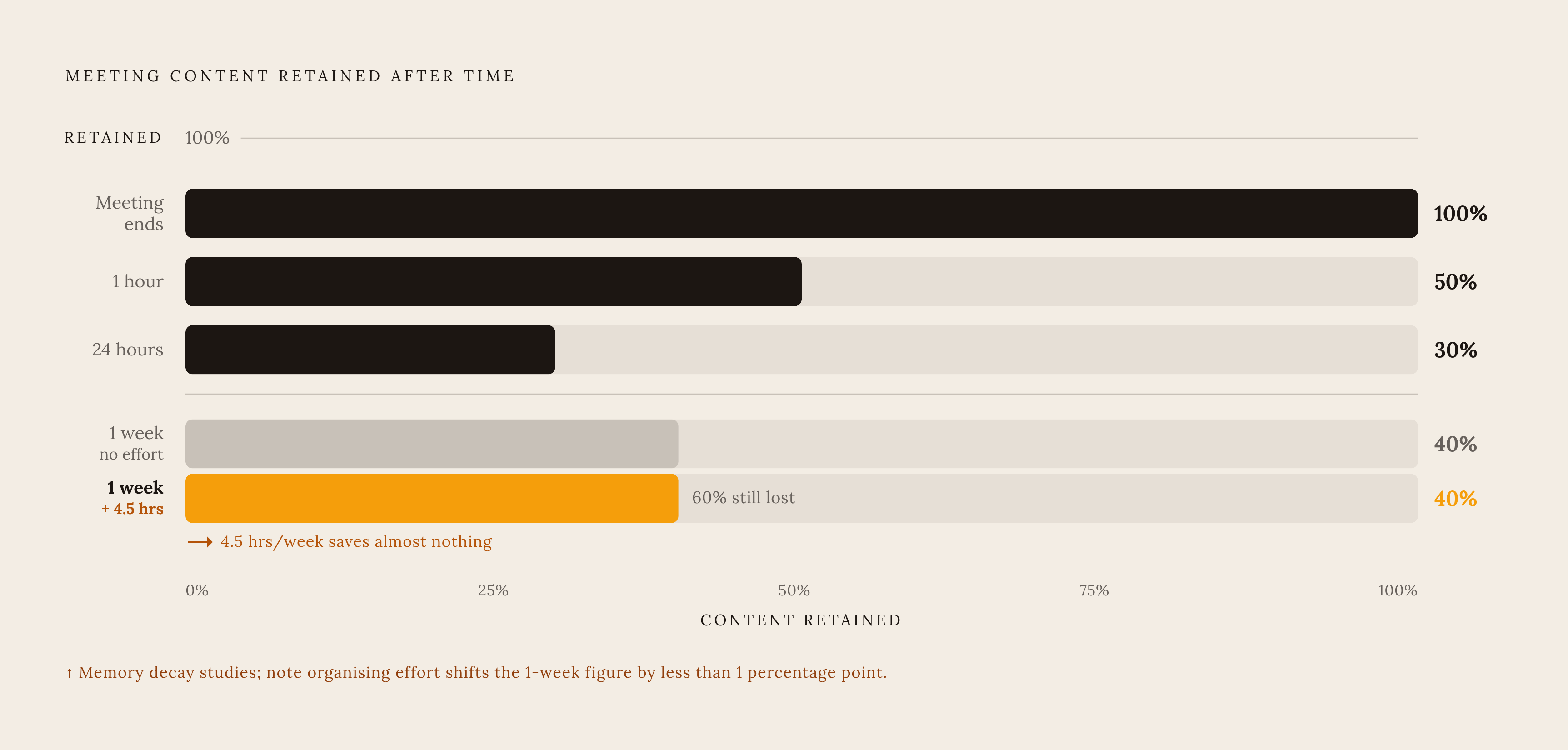
Sources report that forgetting of new information runs close to 50% within the first hour, climbing toward 70% within 24 hours. Whatever the notes missed at the moment of capture, memory was already working against holding onto the rest.
A Harvard Business Review survey found professionals spend an average of 4.5 hours a week organizing meeting notes, and still lose more than 60% of that content within a week. Real, measurable effort poured into cleanup barely dents the decay curve. Time and cognitive load erode what got captured no matter how carefully it was filed or formatted afterward.
The practical failure mode is familiar to anyone who has sat through a follow-up meeting. A detail's absence usually isn't noticed until it becomes relevant weeks later, when someone actually needs to know what was agreed. Reconstruction at that point means re-contacting attendees, scheduling a call just to ask "wait, what did we decide," or guessing. The gap between what happened and what's on record doesn't stay fixed at the size it was on day one. It widens continuously, the longer the notes sit untouched.
Accountability and phrasing gaps that turn incomplete notes into actionable confusion
Missing detail is one kind of failure. Misleading detail is worse, and it's the more common one. Notes that don't record who owns a task and by when aren't just thin, they actively misrepresent the state of things. Passive phrasing is the usual culprit: "it was suggested," "some concerns were raised." No subject, no owner, no deadline.
Teams read intent into these constructions anyway, and they read it wrong more often than not. One person assumes someone else has it handled. No one follows up, because on paper, no one was ever assigned to. The task evaporates quietly, and it often takes a second meeting just to notice its absence.
Formatting makes this worse before it makes anything better. Notes written as one unbroken paragraph, or as bullets with no timestamps and no clear line between discussion and decision, are close to unauditable. Finding the exact moment a decision was made turns into its own research project. In governance and compliance settings, board minutes, regulated committee meetings, regulators and courts treat meeting records as evidence of oversight, so a vague record is a real exposure. Writing more doesn't fix any of this. Fixing it requires structure that doesn't depend on one overloaded human deciding, mid-conversation, what counts as the owner and the deadline.
The organizational cost: how lossy note-taking degrades decisions up the hierarchy
Every step information travels upward through an organization strips something out. A nuanced customer objection raised on a sales call becomes a bullet in a weekly summary, then a single data point in a board deck. The reasoning behind it, the customer's tone, the alternatives someone floated and rejected: none of that survives the climb.
Leadership ends up deciding based on a thinned-out version of what actually happened on the ground. McKinsey research puts the cost of this kind of knowledge loss at $31 billion annually for Fortune 500 companies, a figure that turns the earlier mechanistic argument into something concrete. Incomplete meeting records, compounded across an organization and over time, are a line item on somebody's budget. They're a line item on somebody's budget.
The loss isn't confined to what got summarized badly, either. It includes what never got written down at all: the judgment calls, the internal debates, the offhand customer comment that shaped a decision but never made it into any document. That knowledge walks out the door the day the person who was in the room leaves the company. The incompleteness doesn't stay contained to the meeting where it started. It propagates upward, and it compounds.
AI meeting tools fix the underlying structure of meetings, not just the amount of effort they require
The strongest case for AI meeting note tools has nothing to do with saving typing effort. It's that they remove the dual-task bottleneck entirely: continuous recording, transcription with speaker identification, summary generation, and action-item extraction, none of it requiring a human to split attention between listening and writing. The tool captures while the person actually participates. That's a different approach to the problem, not a faster version of the old one, and the distinction matters more than it sounds.
More than 20 specialized AI meeting note tools were competing for the same market as of 2026. Transcription accuracy has matured alongside that growth: 90 to 95%-plus in English is now common across the leading tools, based on hands-on testing of eight tools across more than 50 real meetings, published by Simular. Accuracy at that level is close to commoditized at this point. The real competition has moved downstream, to how well the notes connect into CRM systems, task tools, and searchable memory across past meetings.
The nonverbal gap doesn't close, though, and pretending otherwise would be dishonest. These tools capture audio and text with real fidelity, but gesture, expression, and posture stay outside the record, exactly as they did with a human note-taker holding the pen.
There's also a real architectural fork buyers face: bot-based tools, where a visible notetaker joins the call, versus botless tools, which capture audio locally with no visible presence. Both address the difficulty of listening and writing at the same time. They solve it with different tradeoffs, particularly around how a visible bot lands on a client-facing call versus an internal one, and how each approach handles identifying who's speaking.
Criteria for evaluating AI meeting note tools
Accuracy is the floor, not the differentiator, and any vendor pitching it as the main selling point is selling last year's feature. A tool that consistently mishears names, numbers, or decisions creates more cleanup work than a human note-taker would have, which defeats the entire point of buying it. The bar across leading tools is 90 to 95%-plus in English, though that number drops meaningfully in multilingual settings: one widely used tool falls to 80 to 85% accuracy in multilingual scenarios according to BibiGPT testing. Anyone running meetings across more than one language should treat that gap as a real constraint.
Good summaries separate action items from general discussion, attach an owner to each one, and read clearly enough to act on, regardless of transcript length. A good tool is measured by whether the output separates action items from general discussion, attaches an owner to each one, and reads clearly enough that someone who missed the meeting can act on it without a follow-up question. It's whether the output separates action items from general discussion, attaches an owner to each one, and reads clearly enough that someone who missed the meeting can act on it without a follow-up question.
Integration depth decides whether captured notes become organizational memory or just another folder nobody reopens. A tool that pushes action items and summaries into Slack, HubSpot, Salesforce, Asana, or Notion automatically addresses the context degradation described earlier, the one that strips detail out as information climbs the hierarchy. A tool that only spits out a downloadable transcript is solving a narrower problem than that: capture, not propagation, and the two are not the same job.
Bot versus botless is an operational decision, not a matter of preference. Bot-based tools tend to offer stronger speaker identification, which helps in larger or less familiar groups. Botless tools fit better on client-facing calls, where a visible third-party bot joining mid-pitch can create friction nobody asked for. Matching the architecture to the meeting type, instead of picking one tool to cover everything, pays off.
Hallucination risk deserves separate scrutiny from transcription accuracy, because the two are different failures. A transcription error misses or garbles what was said. A hallucinated summary invents a commitment or decision that was never made, and that's arguably the more dangerous failure, because it looks just as authoritative as the real thing. Wikipedia's entry on AI notetakers flags this as a recognized ethical concern in the category. A fabricated action item is worse than a missing one, since someone might actually act on it.
Privacy, consent, and compliance controls round out the evaluation, and they belong at the foundation, not tacked on at the end. Meeting audio routinely contains sensitive material: financial detail, personnel matters, unreleased product plans. Tools differ on whether processing happens locally or in the cloud, whether other participants get notified that recording is underway, and whether the tool meets frameworks like GDPR. A product demo doesn't reveal any of that, so someone has to ask about it directly.
A handful of tools show how differently these tradeoffs play out. One botless option built for the category offers unlimited free recording and transcription, capping only its advanced AI summary feature at a limited number of calls a month, and runs across Zoom, Google Meet, and Microsoft Teams. Another, built around real-time transcription across more than 30 languages, offers both bot and botless modes and leans into integrations for teams operating internationally. A third treats the meeting itself as a workflow problem rather than a transcription problem, pricing low per seat and pairing both bot and botless modes with task creation built into the output, a combination that earned it a recommendation from The New York Times' Wirecutter as a top pick for transcribing and summarizing meetings. Yet another positions itself less as a notetaker and more as a searchable knowledge layer, connecting meetings, email, and messaging into something closer to an internal knowledge graph, with an open API for teams that want to build on top of it directly.
None of these close the nonverbal gap, and none of them should be sold as if they do. What they solve is the bottleneck described at the outset: the impossibility of fully listening and fully writing at the same time, at a volume of 31 hours a month, week after week, without something falling through. Incomplete notes were never a discipline problem to begin with. They were a structural one, and the fix has to operate at that same structural level, capturing continuously, routing what's captured into the systems where the work actually happens, and taking the human bottleneck out of the loop as the single point of failure it always was.