Cognitive Load in Meeting-Heavy Knowledge Work
Meetings force four cognitive demands onto working memory at once.
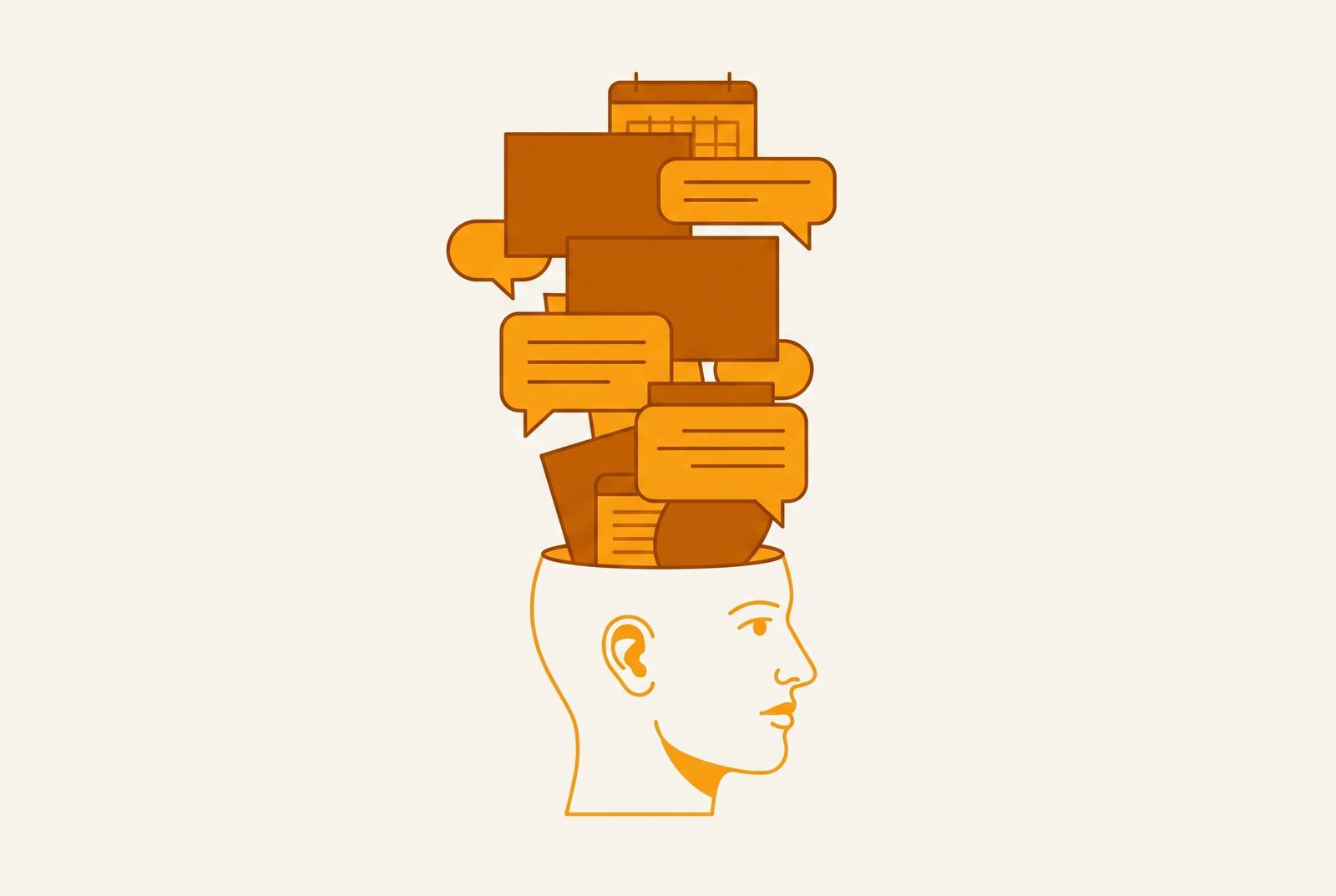
Meetings tax the brain differently than almost any other form of knowledge work, and the mechanism is structural. A meeting forces four cognitive demands to run at once, in real time, with no way to pause or resequence them. Understanding that mechanism is the first step toward managing it.
Most knowledge work lets a person set their own pace. Reading a report, drafting a proposal, reviewing code: all of it can be slowed down, paused, reread, or deferred to a better moment. A meeting removes that control. Comprehension, evaluation, and response all happen live, in parallel, governed by whoever is speaking rather than by the person trying to process what's being said. That's a different problem than information overload, where the volume of material is the issue. In a meeting, the problem is sequencing: there's no way to process one demand before the next one arrives, and no tab to close when it gets to be too much.
Cognitive Load Theory offers the clearest lens for what's happening. The theory treats working memory as a fixed, narrow resource, and it splits the load that resource carries into three kinds: intrinsic load, which comes from the actual difficulty of the subject matter; extraneous load, which comes from how badly or well a task is structured; and germane load, the effortful processing that actually builds durable understanding. A bibliometric analysis of roughly 1,600 CLT publications between 2021 and 2025, published in Annals of Neurosciences, found the field growing at about 28% a year over that period, with one of its three dominant research clusters focused specifically on information and computing in human-centered, AI-assisted work contexts. That's not an accident. Researchers are pointing the framework directly at environments like meetings because the theory explains what happens there better than almost anything else available.
The four simultaneous demands a meeting places on working memory
Every meeting draws against the same limited pool of mental capacity, and it draws from four directions at once.
The first demand is active listening and comprehension. Following spoken language in real time means resolving ambiguity as it happens and tracking who said what, all without the option to rewind. That's harder than reading by a wide margin: a reader controls pace, a listener doesn't. Multi-speaker settings add a second cost on top of that, because the brain has to re-orient every time the speaker changes, and that switching cost accumulates across a long call.
The second demand is evaluation and decision-making. Workers in meetings aren't passive receivers of information; they're expected to weigh proposals, form judgments, and speak up, often within seconds of hearing something for the first time. That requires holding prior context, the current proposal, and a mental list of counterarguments all at once, which is about as intrinsic-load-heavy as cognitive work gets. A study by Lepine and colleagues, published as an arXiv preprint (arXiv:2505.10742), examined 1,178 participant-subtask observations in AI-assisted knowledge work and found that extraneous load had a substantially stronger negative association with performance quality than intrinsic load did. A badly run meeting hurts thinking more than a genuinely hard topic does.
The third demand is social and relational tracking. Reading the room, noticing who hasn't spoken, catching the question that got ignored, gauging where the power sits in the conversation, deciding how to phrase a disagreement without derailing the agenda: none of that touches the substance of the meeting, yet all of it competes for the same working memory as the substance does.
The fourth demand is documentation. Taking notes while listening forces the brain to split attention between comprehending speech and transcribing it, compressing two sequential tasks into one moment. Whatever gets written down was, by definition, not fully processed while it was being written, and whatever got fully processed usually didn't make it onto the page. Of the four demands, documentation is the one most directly addressable by tooling, and it's the one whose removal frees up the most room for the other three.
None of this adds up cleanly. The four demands compete rather than stack. An hour-long meeting can leave someone more depleted than two hours of solitary, focused work.
Interruptions and context-switching compounding the load across a meeting-heavy day
The average professional spends 31 hours a month in meetings, Atlassian research found, which puts the dynamics above at the center of a meaningful share of the working month rather than at its margins.
When interruptions are layered on top of that, the picture worsens. Microsoft's 2025 Work Trend Index found the average employee receives 275 interruptions over a 24-hour period, roughly one every two minutes across an eight-hour day. Each interruption forces a full reset: disengage from the current task, process the new signal, decide how to respond, then attempt to find the thread again. Gloria Mark and colleagues at the University of California, Irvine measured that re-engagement cost directly and found it takes an average of 23 minutes and 15 seconds to fully return to the original task after an interruption.
Most of that load isn't even scheduled in advance. The same Microsoft index found that 60% of meetings are unplanned or ad hoc, so the majority of meeting load hits without any of the cognitive preparation that might soften it.
Load doesn't clear between meetings, either. It carries forward. Unresolved questions, decisions nobody wrote down, tasks that never got offloaded onto a list: all of it becomes residual debt that a worker drags into the next call. By late afternoon, someone who's been in back-to-back meetings since morning is running all four working memory demands on a badly depleted tank.
What workers forget, and why that forgetting is structural
Participants forget roughly half of meeting content within 24 hours, and inattention isn't the cause. Overloaded working memory simply cannot transfer information into long-term storage fast enough to keep up.
CLT explains why directly. Germane load, the productive effort that actually builds durable memory, only has room to operate once intrinsic and extraneous load aren't already eating the whole budget. In a meeting running at capacity on listening, evaluating, and managing the room, there's nothing left over for consolidation, and the meeting ends before it happens.
What disappears first is the reasoning behind decisions: the "why" fades faster than the "what." Action items go next, especially ones with only implied ownership, since anything not explicitly written down and assigned tends to get disputed or duplicated later. Nuance follows the same path; what survives in memory is often a flattened, sometimes distorted version of what the room actually agreed to.
The tax on all this is measurable. A survey of over 1,000 workers found that each employee spends an estimated 146 hours a year reconstructing what was said in meetings, time that should have gone toward the work the meetings were meant to enable. None of this reflects a lapse in discipline or attention. It's a working memory architecture problem behaving exactly the way cognitive science predicts it will. Even a sharp, fully engaged professional cannot simultaneously hold, judge, document, and durably encode a complex multi-party conversation. The ceiling is biological.
How the documentation demand distorts the meeting itself
Knowing that documentation is required changes behavior before a word gets typed. Participants shift mental resources toward capturing what's said rather than thinking about it, and that's a measurable behavioral shift, not just a felt one.
The person taking notes is frequently the least present person in the room. Their attention splits, their contributions lag behind the conversation, and their follow-up questions often go unasked because there wasn't a free moment to form one. Microsoft Research's study of 319 professionals across 936 real-world AI use cases, presented at CHI 2025, found that workers report more critical thinking effort on high-stakes tasks when AI assists them than on equivalent manual tasks, but less critical thinking effort overall with AI than without it. Read against manual note-taking, the implication is straightforward: unaided documentation is the more expensive cognitive path, not the cheaper one.
The distortion doesn't stop with the note-taker. Discussions slow down to give note-takers room to keep up. Decisions get deferred because nobody in the room is confident the decision will be recorded accurately. Microsoft Research names maintaining goal clarity across a meeting as one of the central challenges knowledge workers face, and that challenge only gets worse when half the room is also trying to keep a written record.
Recall that Lepine and colleagues found extraneous load the strongest drag on performance quality. Manual documentation is extraneous load in its purest form: effort spent capturing the discussion rather than advancing it. Removing that demand is a cognitive load intervention, not a productivity hack tucked into a longer list of nice-to-haves. It's a cognitive load intervention, and it changes the quality of thinking available in the room while the meeting is still happening.
What AI meeting tools do to the cognitive load equation
If documentation is the most removable of the four demands, and removing it frees capacity for the other three, then tools built to automate documentation are addressing the problem at its actual source rather than around its edges.
Mechanically, these tools tend to work the same basic way. They join or capture a meeting, transcribe it with speaker identification, generate a structured summary, and pull out action items, all without requiring effort from participants while the meeting is underway. Two capture approaches dominate: bot-based tools that join the call as a visible participant, and device-level tools that use the device's own audio silently in the background. Each carries different implications for how aware participants are that the meeting is being recorded, and for the dynamics of the room itself.
What a worker gets out of the process typically breaks into four pieces: a full, time-stamped transcript; a summary covering what the meeting was about and what got decided; action items with a task, an owner, and a deadline attached; and data structured well enough to route into other tools. Accuracy on this front has become table stakes rather than a selling point: leading tools now run in the 90 to 95%-plus range for English transcription, with single-speaker recordings typically hitting higher accuracy and multi-speaker calls with crosstalk coming in somewhat lower. A large share of professionals now use some form of AI note-taker, which suggests the cognitive relief on offer is widely felt, even where the workers using these tools wouldn't describe it in the language of working memory.
None of this solves the whole problem on its own, though. A flawless summary that lands in a folder nobody ever opens hasn't reduced anyone's load; it's just moved the work of reconstructing what happened from the meeting itself to whatever happens after. That's where the load reduction actually has to finish.
Routing meeting output into existing workflows to complete the cognitive load reduction
The tax doesn't end when the meeting does. Someone still has to create the tasks, send the recap, update the CRM record, and chase down the follow-ups, and that translation work reintroduces the exact burden the automated notes were supposed to remove.
An action item sitting in a summary document is not the same thing as a task sitting in a project tracker. A decision written into a recap is not the same thing as an updated CRM record. Somebody has to copy the content over, paste it into the right place, and re-explain the context so it makes sense outside the meeting it came from. If that step is skipped, the summary, however accurate, just becomes one more document competing for attention.
Genuine integration closes that gap. Action items push directly into tools like Asana or Linear without anyone re-typing them. Sales call outcomes sync straight into a CRM like HubSpot, Salesforce, or Attio, so the decision made on the call becomes the record itself rather than a note that might or might not get filed later. Summaries land in the Slack channel or Notion page where the relevant team already does its work. For teams that need something more custom, API access, MCP connectors, and webhooks let that routing get built into existing internal tooling.
Lepine and colleagues' finding that model-initiated task switching is the strongest predictor of performance decline maps onto this almost exactly. The meeting equivalent is the moment a worker has to stop thinking about the actual project and start thinking about updating the tracker instead. Integration is what removes that switch. Full cognitive relief requires more than automatic documentation: it requires that documentation's output land in the right place without a human being standing in the middle to translate it, so the next piece of work starts with context already intact rather than with a note still waiting to be processed.
The longer-term cost when meeting knowledge doesn't transfer to organizational memory
What disappears when meeting output has nowhere durable to land is more than today's task list. It's the reasoning behind past decisions, the context behind commitments made months ago, and institutional knowledge that would otherwise take a new hire a long stretch of time to piece together on their own.
Brandon Hall Group research found that new hires at large companies typically take six to twelve months to reach full productivity, and a meaningful share of that ramp-up time goes toward reconstructing context and decisions that were never durably recorded. McKinsey's research on Fortune 500 companies puts the annual cost of poor knowledge sharing at an estimated $31 billion, and meetings that produce no durable, searchable record sit near the center of that loss.
The pattern compounds inside teams, too. Senior employees end up carrying meeting context in their heads, while junior or newer employees have no way to reach it, so every hand-off requires another meeting just to re-explain what should have been written down the first time around. Cross-department work suffers along the same lines, when the history behind a prior decision lives only in someone's memory rather than in a record the next team can actually pull up.
Captured systematically and made searchable, meeting data becomes a form of organizational memory. The burden of remembering what got decided shifts off individual employees and onto shared infrastructure instead, so the organization holds the memory and its people don't have to. The individual cognitive load problem traced through this piece and the organizational knowledge loss problem sitting above it are, at bottom, the same failure playing out at two different scales. Fix the mechanism that causes one, and the other starts to close on its own.