Knowledge Transfer Failure Rates During Role Transitions
Tacit knowledge surfaces only in real work, making early departures impossible to fully replace.

Most organizations discover that their knowledge transfer failed only after the person has left, when a decision that used to take an afternoon now stalls for a week. The handover itself looked fine. The documents were shared, the meetings were held, and the successor asked all the right questions. Then the real work began, and the absence started to show.
Why knowledge transfer failures happen after the person leaves, not during the handover
Knowledge transfer failures are structurally deferred. They do not announce themselves during the handover period, when everyone is present and attentive and the checklist is being worked through. They emerge weeks or months later as quiet underperformance, as delivery slows, and as decisions drift back to whoever held the role before. The handover looks like it worked until the successor hits a situation the documentation never covered.
This deferred visibility is what makes the problem structural rather than instructional. When a transition struggles, the instinct is to examine training quality or documentation depth. In practice those are rarely the root causes, because the failure was not introduced by a bad handover session or an incomplete document. It was introduced by design choices made long before the handover began, and a behavioral fix applied at handover time cannot address a failure that only becomes visible in production. The successor inherits the role, operates within it for months, and only then hits the edge of what was actually transferred. By that point the departing person is gone, the informal channels are closed, and the organization is left to rebuild knowledge it did not know it had lost.
What organizations actually lose when someone leaves, beyond what the job description captured
What causes failures when it disappears is not the knowledge that gets documented. The knowledge that gets documented is the knowledge that was already visible, already articulated, already safe. What organizations actually lose falls into three categories with fundamentally different transfer properties, and most handover processes only reach the first one.
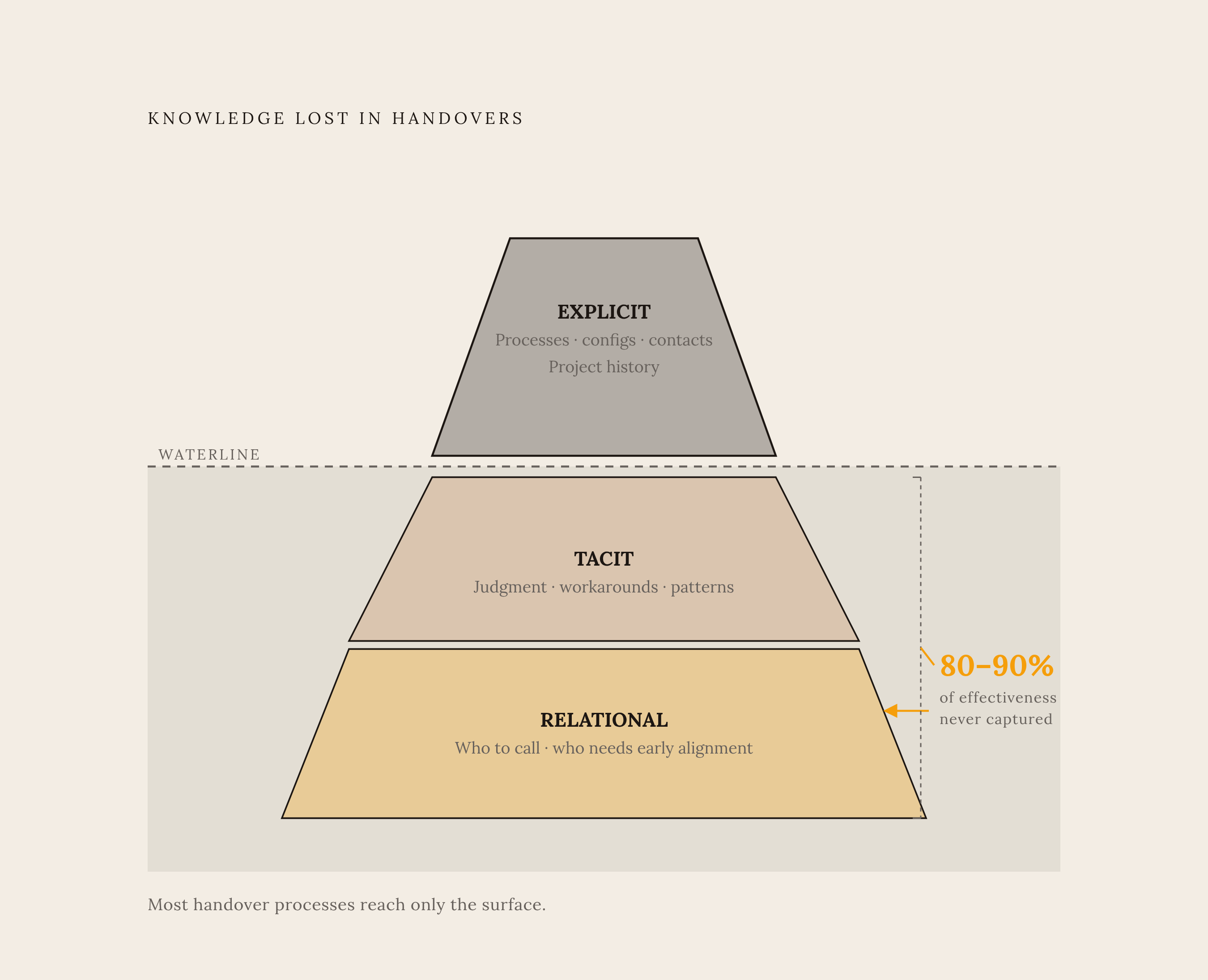
Explicit knowledge is the easiest to transfer because it is already captured: processes, configurations, named contacts, project histories. But explicit knowledge represents only a fraction of what makes someone effective in a role. Tacit knowledge is the experience-based judgment that the holder may not even realize they possess. It is the workarounds that were never written down, the reasoning behind decisions made years ago, the pattern recognition that fires only when a specific situation triggers it. Relational knowledge is who to call for what, which stakeholder needs early alignment, which vendor contact actually returns calls. It transfers only through introductions and shared interactions, never through documents. The iceberg framing captures the asymmetry precisely: explicit knowledge is the visible fraction above the waterline, while tacit and relational knowledge is the submerged mass, the 80 to 90 percent below the surface, that most handover processes never reach.
An exit interview cannot reliably surface tacit knowledge, and the reason is definitional rather than procedural. Tacit knowledge is difficult to articulate on demand. It surfaces in context, through doing, not through recollection in a conference room. Asking a departing specialist to inventory everything they know produces a list of what they can consciously reconstruct, which is precisely the explicit fraction that was already available. The knowledge that will cause failures later is the knowledge that no one thought to ask about because no one, including the holder, knew it was load-bearing until the situation that needed it arrived without warning.
Why role-to-role replacement is a design flaw, not a neutral planning choice
The dominant transition planning model is to replace a role with a person at the same nominal level. This treats job titles as proxies for accumulated knowledge, which they are not, and that mismatch is where most structural failures originate. A role that has existed for eight years carries eight years of judgment, relationships, and context a job description never captured. Matching the description does not begin to match the role.
The mismatch becomes vivid when experience calibration is measured against product maturity. If a product is maturing, five to ten years old, an incoming team needs six to nine months and senior calibration to genuinely contribute. For products in a retiring stage, ten years or older, the requirement extends to nine to twelve months, still with senior calibration. When the calibration of incoming experience does not match the maturity of what they are inheriting, teams spend disproportionate time ramping instead of contributing. What later looks like a knowledge transfer failure was often a design flaw introduced at the very beginning: the wrong person was matched to the wrong complexity, and no amount of handover diligence could have closed that gap.
The same logic applies to individual role transitions, not just large global capability center programs. A mid-tenure successor replacing a long-tenured specialist is structurally under-equipped regardless of matching job grades. The title says the same thing, but the accumulated tacit and relational knowledge behind the title is an order of magnitude apart. The organization has not made a neutral planning choice. It has under-provisioned the successor from the outset, and the structural deficit will express itself as their failure later.
How the timing of handover initiation determines what can realistically be captured
Starting knowledge transfer at the point of resignation is structurally incompatible with recovering the knowledge that matters most. Tacit knowledge transfer requires time, repetition, and context, and a two-week notice period cannot provide any of those. Notice periods are calibrated to operational continuity, not knowledge transfer completeness. Two weeks covers transition logistics: where files live, who approves what, which meetings recur. It does not cover months of accumulated judgment.
The deeper problem is that tacit knowledge cannot be inventoried on demand. The departing person often cannot list what they know because they do not consciously hold it as a list. It emerges when a specific situation triggers a workaround, a judgment call, or a relationship activation. Those situations cannot be manufactured during a two-week wind-down. They arise in the course of actual work, at unpredictable moments, and the successor only discovers the gaps when those moments arrive months later, alone.
The confusion between process completion and knowledge completion is where most handover definitions go wrong. Knowledge transfer defined as done by training completion or document handoff has no defensible relationship to whether ownership has actually moved. Completion inferred from activity, training delivered, documents shared, shadowing cycles concluded, creates the impression that knowledge has moved even when ownership has not. A more defensible definition focuses on delivery behavior: the successor demonstrates comparable reliability and independence within an agreed scope, measured against a pre-transition baseline. That is a standard a two-week notice period can almost never meet, which is why the timing of initiation, not the diligence of the final sprint, determines what can be captured.
Where informal channels carry the knowledge that formal processes never document
Most organizational knowledge transfer happens informally, in conversations and interactions that leave no persistent record. This means the channel through which most knowledge actually moves is exactly the channel that closes when someone leaves. Formal documentation processes capture explicit knowledge, the fraction already above the waterline. The informal channel is where tacit knowledge moves: the hallway conversation that explains why a decision was made, the side call with a vendor contact, the meeting where a recurring problem's history is narrated for the first time.
When the departing person leaves, those informal channels close permanently. The successor cannot query conversations that were never captured. They cannot reconstruct the reasoning behind undocumented decisions. They cannot inherit relationships that were never formally introduced. The consequence is that successors spend months re-deriving context the departing person carried effortlessly, recreating knowledge that existed in conversations but was never preserved as organizational memory. The work gets done eventually, but at a cost the organization does not measure because it appears as ordinary ramp-up rather than as a transfer failure.
Persistent, searchable records of meetings change this structural equation. When meetings are captured and made queryable, an informal channel becomes retrievable organizational memory. A successor can query what was actually discussed, what decisions were made and why, and what commitments were given, rather than inheriting only the documents that someone chose to write afterward. The distinction matters because the documents are a selection made by the departing person, filtered through what they considered worth writing down. The meeting record preserves what was actually said, including the context and reasoning that never made it into any document. That is the informal channel, still open after the person who carried it has gone.
Why knowledge fades even when the handover appears to have worked
Even a well-designed and well-timed handover can fail structurally because of how incoming people are deployed after go-live. Knowledge transfer does not end when the departing person leaves. It enters a second phase in which transferred knowledge either compounds into genuine capability or erodes through disuse. One specific erosion pattern is well documented: when engineers are rotated across modules too quickly or consistently assigned low-risk work, they never stay with a problem long enough to develop judgment. Each shift resets the ramp-up curve, and the knowledge that was transferred begins to decay before it has been exercised enough to become instinct.
The early warning signals of this erosion are observable if anyone is looking. Critical deliveries continue to sit with the predecessor or the manager despite the successor being nominally in the role. Teams rotate frequently across problem areas. Productivity metrics flatten without clear technical causes. None of these signals appears in a handover checklist because they occur after the handover has been declared complete. The process has already moved on, and the erosion is attributed to the successor's capability rather than to the deployment choices that denied them meaningful ownership.
Voluntary attrition compounds the problem. When capable successors are repeatedly kept away from meaningful ownership, they draw their own conclusions about the role's actual scope. The knowledge transfer investment then walks out the door a second time, a dynamic reflected in the roughly 12.6% voluntary attrition rate currently seen across Indian GCCs. The structural implication is that knowledge transfer requires sustained deployment conditions, not just pre-departure documentation. Transition planning must include post-go-live work allocation, because what happens in the months after the handover determines whether the transfer becomes embedded judgment or simply fades into the background of a successor who never fully arrived.
What a structurally sound transition process is actually designed to measure
A transition process designed around these structural failure mechanisms looks nothing like a checklist. It defines completion as demonstrated independent delivery, measures it against a pre-transition baseline, and treats the six weeks after go-live as the most critical phase of the transfer, not the epilogue. The design criteria follow directly from the failure mechanisms. Knowledge capture begins before departure is announced, because continuous capture through meeting records and documented decisions is the only way to build a transferable record of tacit knowledge while it is still being exercised. Incoming experience is calibrated to product or role maturity, not to a departing job title. Completion is defined behaviorally: can the successor operate independently within an agreed scope, without escalation, measured against a pre-transition delivery baseline? A small number of delivery metrics, delivery frequency, cycle time, predictability, quality, are used consistently across both teams, rather than training completion serving as a proxy for readiness. And post-go-live deployment is protected, assigning the successor meaningful ownership of the same problem areas long enough for transferred knowledge to compound into judgment. The test of whether a transition has succeeded is not whether handover documents were delivered. It is whether the successor, some months in, makes decisions that reflect the full context of the role, including the tacit and relational knowledge that no checklist captured and no exit interview could extract.