Ramp Time Benchmarks for Meeting-Heavy Roles

Ramp time benchmarks for meeting-heavy roles measure more than how quickly a new hire learns to sell. They reflect deal complexity, the endpoint being measured, and access to organizational context. Structured onboarding builds essential skills, but searchable meeting history addresses a different constraint, namely the time new hires spend reconstructing what experienced colleagues already know.
Why ramp time benchmarks vary so much across sales roles
“Ramped” has at least three meanings in active use, including time to first closed deal, time to full quota attainment, and time to certified competence. These endpoints measure different achievements, so their benchmarks are not interchangeable. Two companies can both report a 90-day ramp while one means full quota attainment and the other means finished onboarding. A comparison is useful only when the endpoint matches. Role-by-role analysis is therefore the starting point and requires a defined measure.
Even within a role, four variables explain much of the spread, namely deal cycle length, when the clock starts, prior industry experience, and territory quality. Starting the clock after formal onboarding excludes time that another company counts from day one. Likewise, a rep who inherits warm pipeline has a different path to revenue from one who starts in a cold greenfield territory. These differences can make equivalent selling ability look like unequal ramp performance.
Ramp time benchmarks by role in 2026, and what each number actually measures
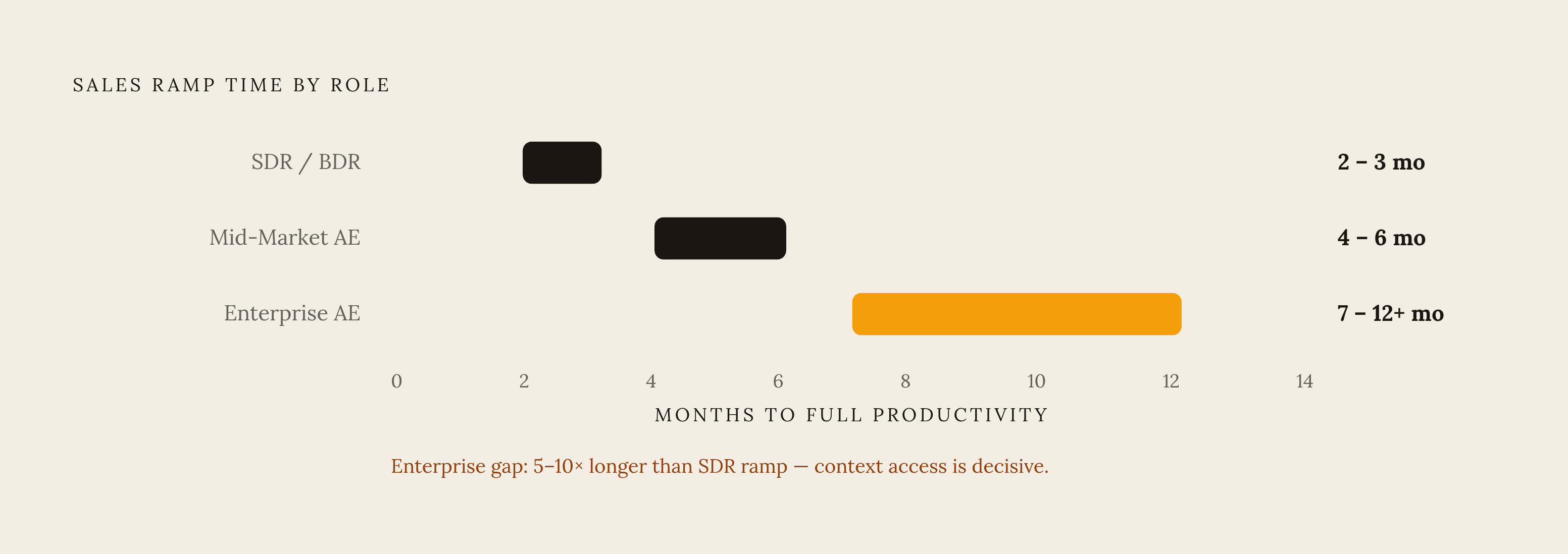
SDR and BDR roles take an average of 3.1–3.2 months to ramp, while the best teams reach productivity in 2–3 months. This benchmark has been stable for years because quota is measured in meetings booked. A new SDR can book a first meeting in week two without waiting for a full buying cycle. The milestone sequence runs from first outbound activity by week two to a first qualified meeting by weeks three to six, consistent meeting generation by month two, and full productivity by month three.
Mid-Market AEs average 4–6 months, with first opportunities created around month two and full quota reached by months four to six. Buying committee size and territory quality introduce meaningful variation within that range. Enterprise AEs average 7–12 months for most roles, with complex, high-ACV deals pushing toward the longer end and some ramps extending well over a year. A capable enterprise rep may therefore be performing well before closed revenue demonstrates it. Pipeline build, deal progression, and stage advancement are more useful signals during that interval.
Role is a useful first predictor because it broadly captures the work, but deal complexity explains the underlying constraint. Fintech and payments add regulatory knowledge requirements, while healthcare and MedTech add HIPAA literacy and clinical buyer fluency. With more to learn, reps in these roles tend to ramp toward the longer end of their bracket. Cohort ramp time, measured across reps hired in the same quarter and territory type, makes the benchmark more actionable by showing whether onboarding performance improves over time.
Why average ramp time has been climbing for five years straight
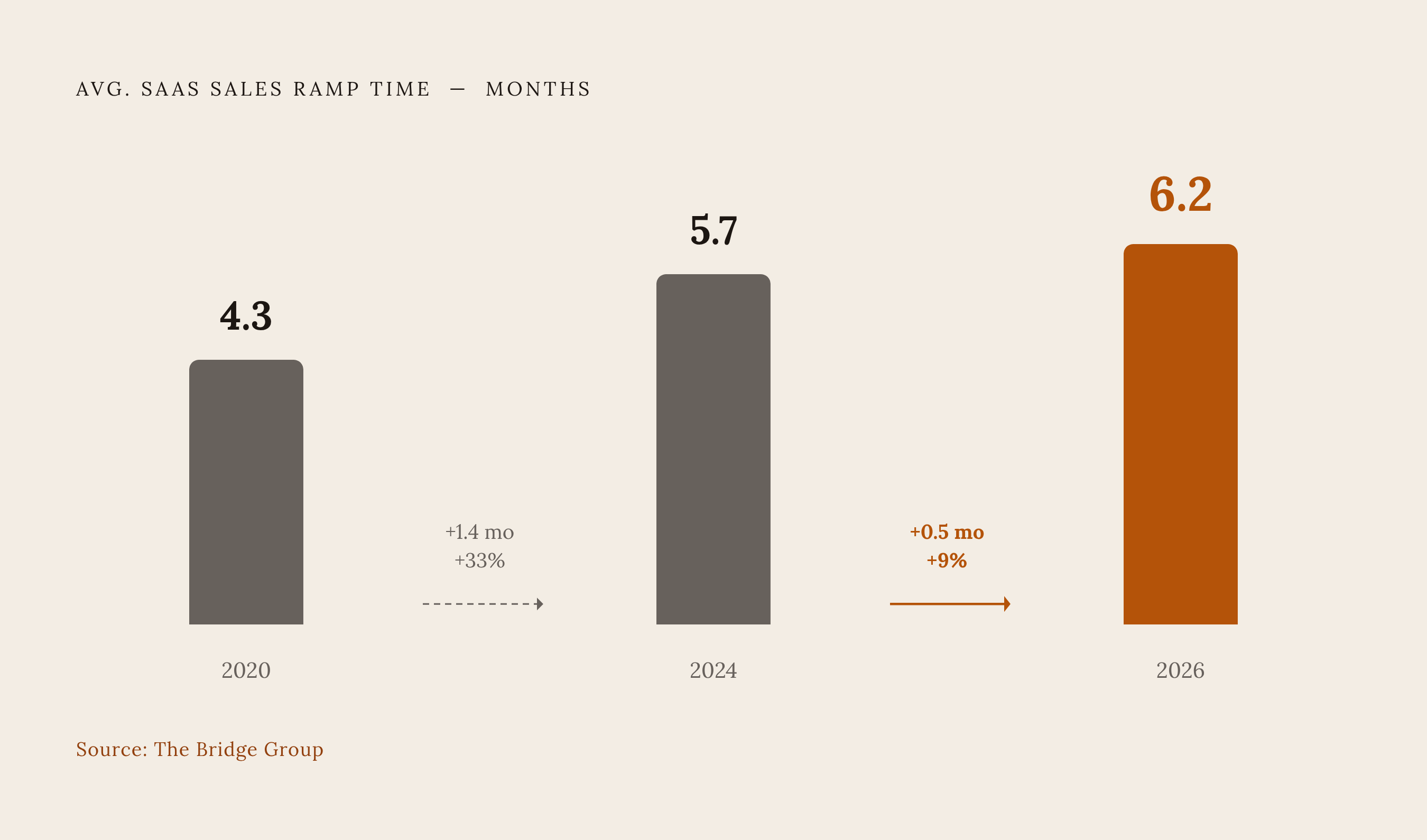
The Bridge Group’s benchmark data puts average SaaS ramp at 4.3 months in 2020, 5.7 months by 2024, and 6.2 months by 2026. The increase to 2024 alone is roughly 32%. With more features, integrations, and buyer personas, a rep has more to learn before they can speak with buyers credibly. Prospects have already read reviews, comparison sites, and competitor content, so reps have less room to rely on generic messaging.
At the same time, wider manager-to-rep ratios dilute the coaching available to each hire. Companies are requiring more prior experience and still waiting longer for new hires to produce, which makes hiring quality an insufficient explanation. Longer ramp also extends the period of salary cost before expected productivity, with the effect multiplied across a cohort. More content and longer onboarding programs can address part of the knowledge burden, but they do not remove the constraint on experienced colleagues’ time.
What conventional onboarding programs get right, and where they stall
Structured onboarding gives new hires a defined path to competence. Role-specific milestone plans establish checkpoints that rep and manager can use to agree on what success looks like. Practice before live exposure lets reps rehearse the pitch without learning at the pipeline’s expense. Scheduled manager involvement makes coaching part of the program rather than something available only when time permits. These steps build specific skills and make it easier to judge progress than knowing only whether a rep finished a course.
Their limit is the kind of knowledge they transfer. Product training, ICP definitions, process documentation, and objection playbooks explain what the organization expects a rep to know and do. They do not necessarily explain why an inherited account stalled, what a particular buyer cares about, or how the team handled a competitive objection last quarter. That history is in sales calls, deal reviews, QBRs, and coaching sessions.
Why meeting context is the specific knowledge gap that slows new hires most in complex roles
Complex deals involve multiple stakeholders, long timelines, and changing requirements. As those conditions change, conversations keep a record of why deals moved forward and what led to objections and commitments. A CRM activity history can show that a call happened without explaining what concerned the buyer or what the previous rep promised to follow up on. The new hire inherits evidence of activity but not necessarily the judgment needed to continue it. This is the context-access gap that makes an apparently established territory difficult to work.
The distinction explains why improvements that help SDRs do not fully resolve enterprise AE ramp. Practice volume and playbook quality improve selling skills, but neither supplies the account-level knowledge accumulated through months of conversations. When the people who hold that knowledge leave, or access to it disappears, the new rep must reconstruct it. Even when a manager knows the history, they have little time for coaching, so passing it on is slow and uneven. For complex roles, ramp can therefore track the time needed to recover institutional memory as much as the time needed to learn the product.
Deal cycles still set limits on when revenue can close, and the quality of a territory still affects the opportunities a rep has. A rep who lacks the reasoning behind past decisions faces a different problem from a rep who cannot deliver the pitch. Treating both as training failures obscures the intervention each requires.
How AI meeting intelligence creates a structural advantage for new hires in meeting-heavy roles
AI meeting intelligence addresses this bottleneck by making conversations accessible to people who were not present. Automatic transcription, structured summaries, and action-item capture keep a record of what was said in a meeting after it ends. A tool that covers both online and in-person meetings can keep that record across client calls, deal reviews, and coaching sessions. The onboarding value comes from turning those records into retrievable context. A new hire gains a starting point that does not depend entirely on another person’s memory or availability.
Before an inherited account’s first live conversation, the rep can search past calls, review deal summaries, and learn which objections surfaced and how they were handled. Cross-meeting recall makes this materially different from a folder of transcripts. It allows a focused query about an account, topic, or speaker rather than requiring the rep to inspect each meeting separately. Pattern-based onboarding can also show situations that come up again and again across more conversations than a manager has time to review one by one. The resulting advantage is access to accumulated experience without having to attend every conversation that produced it.
That advantage grows with context dependence. SDRs have short feedback loops, so practice and their current work can help them become competent fairly quickly. Enterprise AEs also need to know what has happened in a buying process that may already have lasted months. Directed review can shorten that learning interval, although it cannot remove the sales cycle itself.
How meeting intelligence connects to the workflows where ramp progress actually happens
Meeting intelligence affects ramp only when its outputs reach the places where new hires work. A summary stored in a separate application can remain disconnected from the account decision it should inform. By contrast, automatically syncing summaries, action items, and deal-stage updates to the correct Salesforce or HubSpot record puts context beside the opportunity. The experienced rep who created the history already knew it, while the incoming rep gains access to knowledge that would otherwise need to be reconstructed. This makes the handoff a particularly valuable point of integration.
The same principle applies to follow-up and coaching. A competitor mention can create a follow-up task with a competitive reference attached, making relevant material available when the new hire needs it. A deal-stage advance can trigger a Slack notification to the manager, bringing coaching forward from a later check-in to closer to the event. Action items from onboarding calls can route into Linear or Asana so the task list reflects actual commitments. MCP connectors and APIs can also make meeting context available to AI assistants such as Claude or Cursor, allowing retrieval without switching applications. These workflows matter because captured knowledge reduces ramp only when it changes what the rep can access and do.
What to look for when evaluating a meeting intelligence tool for ramp and onboarding use cases
For onboarding, the useful output is not a transcript alone but structured decisions, action items with owners, and CRM-ready fields. For global sales teams, multilingual accuracy is an early filter because performance in clear English does not establish performance in other languages. Cross-meeting search is the more specific test of onboarding value. A tool that stores notes but cannot retrieve them by account, topic, or speaker leaves the central access problem unresolved.
Integration depth determines how much of that retrieved context reaches daily work. Putting a summary in Slack is different from filling in Salesforce opportunity fields with stage, decision criteria, and next steps. Evaluate integrations by the work they support. Having a choice of how to record also matters because a visible meeting bot works for some conversations while desktop recording may work for others. Where a third-party participant would be unwelcome, the recording method still has to meet consent and governance requirements.
Retention settings, consent disclosure support, and data access controls set the rules for how meeting history can be used. For meetings that could include PHI, a BAA is required. Meetings that include EU data subjects must comply with GDPR and have an appropriate lawful basis. Check whether the tool’s defaults fit the organization’s policy or need to be set by hand, since broader recall is useful only when the right limits on access are in place.
How to measure whether meeting intelligence is actually reducing ramp time
Measurement should connect a change in context access to a defined ramp milestone. Days to first independent customer call measures when a new hire can lead a conversation without a senior rep present. Days to first qualified opportunity created tests whether a rep who is ready to lead a call can also do good discovery. For enterprise AEs, deal progression during months two through four provides a signal before closed revenue becomes observable. These measures distinguish earlier competence from the unavoidable wait for a long deal cycle to finish.
Manager coaching time adds another view of the mechanism. If meeting intelligence helps, managers should spend less time repeating account history and more time on deal strategy for what comes next. Compare cohorts that use meeting intelligence with earlier cohorts or a control group, while controlling for the quality of the territory and the type of deal. Use the role-specific benchmarks as the baseline and the available top-performing range as the target, keeping the definition of productivity consistent. This avoids crediting the tool for a stronger territory or blaming it for a longer buying cycle.
If ramp does not change, check whether meeting outputs reach CRM records and project tools. Notes can exist without changing what a new hire can access at the moment context is needed. Separating capture, access, and milestone progress makes the investment defensible and identifies where the workflow stalls. As usable meeting history accumulates, successive cohorts can inherit a stronger starting point. The practical conclusion is that context-driven ramp delays can be measured, isolated, and reduced rather than accepted as an inevitable cost of complex selling.