RAG Pipelines Built on Organizational Meeting Archives
Governed meeting transcripts enable reliable RAG for organizational decisions.
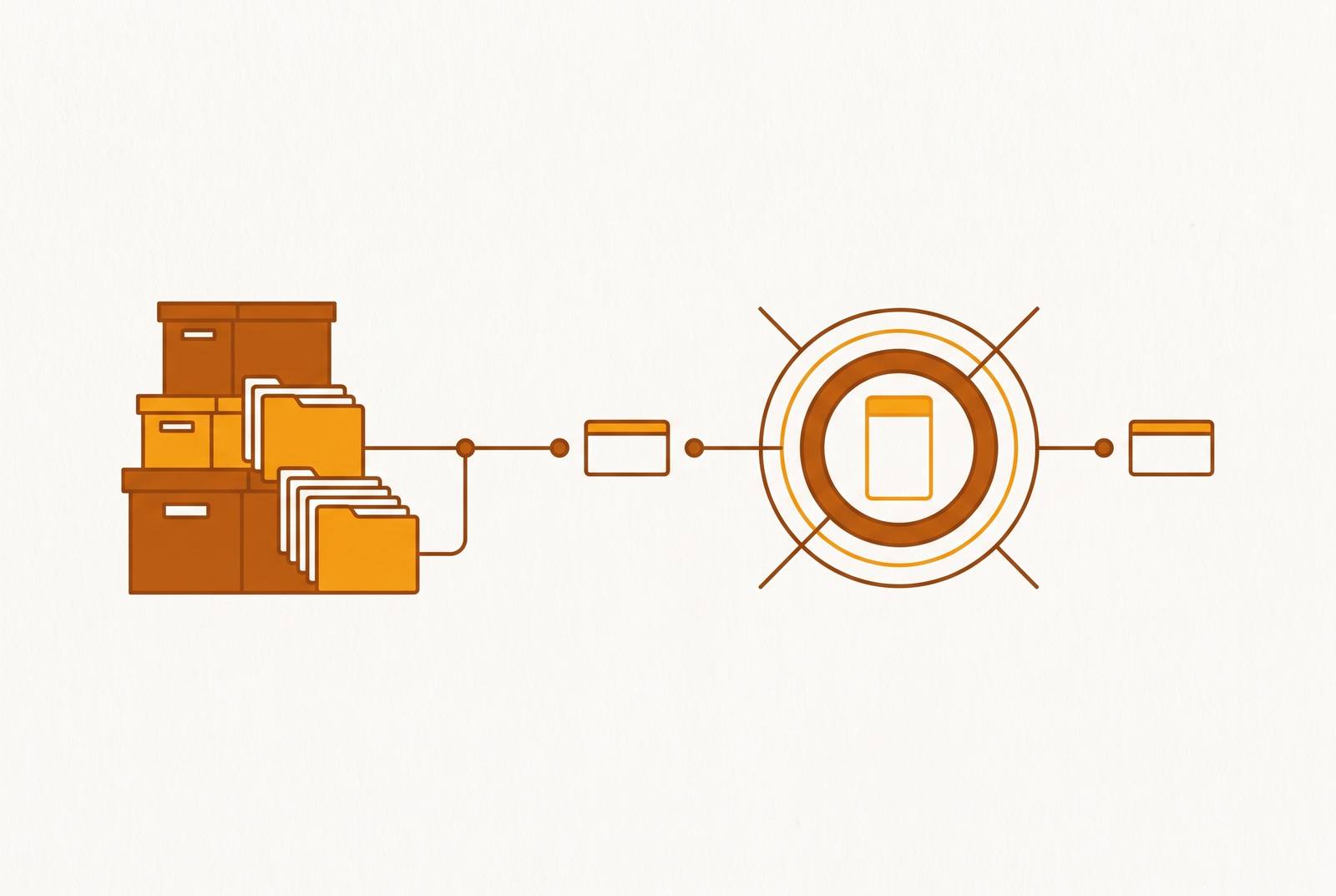
Reliable cross-meeting search for past decisions and commitments requires a governed meeting corpus. To find a decision made three months ago, retrieval needs date and project filters, preserved decision context, and a source identifying the meeting, timestamp, and speaker. RAG pipelines built on organizational meeting archives become dependable when transcription quality, ownership, chunking, permissions, and freshness are treated as engineering requirements from the start.
Why meeting archives are a natural but underbuilt RAG corpus
Live conversations hold knowledge that rarely makes it into a system of record. Planning sessions reveal constraints, customer calls bring up objections, and discussions capture why decisions were made. Documents may say what was decided but leave out the conditions that made the decision reasonable. Those missing conditions are precisely what a grounded answer needs when someone asks why a team chose one course over another.
Yet organizations often use several video and calling tools for these conversations. Records remain tied to individual meetings and participants without being organized into a managed dataset. Circleback captures and organizes conversations across meetings, providing one option for bringing notes, action items, and search into a unified retrieval surface. That consolidation makes ingestion more practical, but it does not itself establish corpus quality or governance. Engineers need to turn captured conversations into records that make clear what they mean, what authority they have, and who is allowed to see them.
How meeting transcription works and where it introduces corpus error
The transcription pipeline sets the first limit on corpus quality. Automatic speech recognition converts audio into text, speaker diarization attributes speech, and an LLM produces summaries, action items, and classifications. Those structured outputs bring any errors left over from the earlier stages into the corpus.
Vendors usually base their accuracy claims on read-speech benchmarks. Real meetings are harder to transcribe when voices overlap, there is background noise, accents vary, and microphones differ in quality. A word error rate that is good enough for routine action-item extraction may fall short of what legal transcription or medical documentation needs. Corpus labels and query expectations need to reflect that distinction rather than treating every transcript as equally authoritative.
Custom vocabulary training, dedicated hardware microphones, and corrections made by people before ingestion can make the results more accurate. Structured, human-correctable outputs, such as the notes and action items produced by Circleback, make that correction step practical. Its workflow guidance calls for reviewing names, critical numbers, dates, and sensitive wording, and correcting ambiguous owners or deadlines. The important boundary is ingestion, because a polished summary does not repair an error in the evidence beneath it.
The document ownership problem that makes meeting corpora non-deterministic
Once transcripts accumulate, individual accuracy gives way to a second problem, namely competing versions of the same record. An older copy and a newer copy can receive similar retrieval scores without giving the model a basis for choosing between them. Engineering teams may leave ownership unresolved until a compliance audit or an answer drawn from the wrong context exposes the gap. At that point, retrieval tuning cannot substitute for a canonical source.
Every ingested document needs a metadata contract. The owner identifies the person or team accountable for accuracy, while source_system identifies the canonical origin. The last_validated_date records when a human last confirmed that the content was current. The sensitivity_label carries Public / Internal / Confidential / Restricted, and version explicitly supersedes prior versions. These fields must be added before indexing so that governance can filter by attributes the store can query.
Meeting chunks also need speaker, date, meeting type, participants, and related project or account. Integrations with CRMs and project management tools, including those available through Circleback, provide a way to connect meeting context to organizational entities at capture time. These relationships give retrieval precise filtering axes. When employees leave or teams restructure, records need reassignment or review, and ungoverned documents should be demoted from the active index.
Chunking meeting transcripts is a different problem than chunking documents
Chunking has unusually high leverage in meeting retrieval because conversational boundaries do not resemble document boundaries. Fixed-size chunks with token overlap are fast and simple, but they can split an utterance mid-thought or separate an action item from its motivation. A fragment may contain the right terms while omitting the qualification that makes them useful. More overlap does not establish where a decision begins or which exchange explains it.
Semantic chunking groups topically coherent utterances and better matches conversational structure, at the cost of more computation during ingestion. Speaker-turn chunking preserves attribution but makes the conversational turn, rather than the topic, the unit of retrieval. That tradeoff suits queries where speaker identity matters, though the relevant explanation may span several speakers. Hierarchical chunking indexes both the meeting summary and each topic segment, which gives long meetings the best precision-plus-context tradeoff but takes more work to build and maintain.
The chunking strategy also depends on the embedding model, so model changes require revisiting chunk boundaries and re-indexing. Better input structure reduces the difficulty of that work. A summary followed by topic sections, decisions, and action items already supplies a useful hierarchy. Circleback’s structured meeting outputs fit that pattern as a pre-ingestion formatting layer. The advantage is not formatting alone, but a clearer relationship between the retrieved detail and the conversation that gives it meaning.
Hybrid retrieval and reranking for conversational corpora
The same project names, technical terms, and references to customers appear in many conversations in meeting archives. Dense vector search can miss exact terminology, while keyword search can miss the relationship between a question and a differently worded decision. Hybrid retrieval combines BM25 lexical matching with dense vector similarity to cover both needs. Reciprocal Rank Fusion merges their ranked results without requiring labeled training data, making it practical where annotated relevance judgments are scarce.
Candidate count creates a further tradeoff. A low top-k can omit evidence scattered across several meetings, while a high top-k admits many chunks that merely repeat the same vocabulary. A cross-encoder reranker rescores the candidates using full query-chunk interaction, recovering precision without applying that expensive step to the whole corpus. HyDE, or Hypothetical Document Embeddings, offers another pattern for questions about rationale by embedding a generated hypothetical answer and using it to retrieve real passages. That generated passage serves only as a retrieval aid.
Metadata filters should restrict the search by date range, meeting type, participant, or project before vector search executes. For a decision from three months ago, limiting the search by time and project cuts down the candidate set before semantic ranking begins. For a commitment, preserved attribution helps distinguish who accepted the work from who merely discussed it. Cross-meeting search therefore depends on lexical, semantic, and metadata signals working together.
Access control for meeting archives must happen before retrieval, not after
Output-layer filtering is not a substitute for access control. Suppressing a final answer does not prevent unauthorized meeting content from reaching the retrieval and generation path. Discussions of personnel, conversations about compensation, legal deliberations, and customer-confidential calls were meant for limited groups of people. Indexing them does not enlarge those audiences.
With Store-per-tenant isolation, each tenant or organizational unit has its own vector index. Separate indexes provide a structural boundary, but operational overhead grows with the number of tenants. A multitenant store instead colocates records and applies security trimming to every request. Before vector search, the server must derive metadata filters from the user’s identity claims and authorization context.
PII requires an additional defense because embeddings preserve semantic content from the source text. Sensitive personal information indexed into a shared corpus can become relevant to an unrelated query in the same semantic neighborhood. Pre-ingestion scanning with tools such as Presidio or Amazon Macie can identify content for redaction or exclusion before embedding. Sensitivity labels then provide another enforcement point at query time. Building retrieval first and authorization later leaves an architectural defect and can require a full redesign.
Recording consent and legal compliance as prerequisites for corpus ingestion
Retrieval permissions cannot cure an unlawfully recorded source. Before ingestion begins, an organization needs a recording policy that addresses notice, the appropriate legal basis, intended use, access, and retention. A visible recording bot should not be treated as proof of informed agreement. Participants need to understand what is being recorded and how the resulting record will be used.
The legal requirements also depend on the processing involved. Illinois’ Biometric Information Privacy Act requires written consent before collecting, storing, or using covered biometric data, including voiceprints that AI notetakers may generate for speaker identification. Speaker diarization therefore raises a question beyond ordinary transcription when it involves voiceprints. GDPR presents a different issue for employment-related processing, where consent is generally not an adequate legal basis because of the employer-employee relationship. Contract performance, legitimate interest, or legal obligation may be the right basis to use instead.
Teams should consult counsel for their specific jurisdictions rather than treating recording settings as a legal determination. The capture tool must support the policy that results from that review. With both visible bot recording and bot-free desktop recording, Circleback illustrates why recording mode is a compliance choice. Bot-free capture does not remove the need for an appropriate recording policy. Consent and compliance belong at the admission boundary of the corpus, before any recording becomes retrievable.
Connecting meeting archives to AI agents through MCP
A governed corpus becomes useful beyond its search interface when AI agents can query it directly. The Model Context Protocol is a standard way to connect assistants such as Claude and ChatGPT to external data sources. For meeting archives, that connection exposes decision rationale, planning constraints, and customer context that documents and tickets may omit. The system that serves the records still needs to enforce user-level permissions.
Provenance is equally important at this boundary. Every retrieved chunk must identify its meeting, timestamp, and speaker so that an agent’s answer remains tied to a citable record. Without those details, organizational memory becomes a confident assertion that the reader cannot inspect. MCP supplies an integration layer that depends on the ownership, authorization, and retrieval work beneath it.
Circleback exposes an MCP connector, API, CLI, and webhooks for bringing meeting context into tools including Claude, ChatGPT, and Cursor. These interfaces make the archive available to agent workflows without requiring a custom connector for each use. For commitment tracking, the useful evidence spans the original assignment and relevant later discussions. Retrieval can bring those records together, but an answer about follow-through still needs supporting evidence rather than an assumption that an assigned action was completed.
Evaluation, freshness, and the operational work that keeps the corpus reliable in production
Corpus drift is the silent failure mode after launch. Meetings keep happening and decisions change, but old records are still semantically similar to current ones. A system can therefore return fluent, well-cited answers that no longer reflect organizational reality. Freshness requires ongoing management together with retrieval quality.
An evaluation harness needs a ground-truth question set and repeatable tests on significant corpus or model updates. Faithfulness scores show whether retrieved chunks support the claims an answer makes, while context precision shows how much of the retrieved material is relevant. Low scores point toward problems in retrieval, chunking, metadata filtering, or reranking. LLM-as-judge and retrieval-augmented generation evaluation frameworks can automate parts of that work, with observability making degradation visible before complaints become the primary signal.
Maintenance also needs a clear separation between offline indexing and online querying. Asynchronous ingestion handles new meeting records, while full re-indexing absorbs embedding model changes and chunking revisions. The indexing flow handles changes to documents in batches, while the query service needs clear budgets for cost and latency at each stage. Ownership handoffs and automatic demotion of ungoverned or unvalidated records keep stale material from retaining authority by default. That continuing discipline separates a meeting corpus that erodes trust from one that becomes a durable organizational asset.