Vector Search Over Meeting Transcripts in Enterprise Deployments
Storing transcript structure at ingestion time determines whether enterprise search works later.

A system that lets you type "what did we promise about pricing" and get back the exact twelve-second clip, out of hundreds of calls spanning months, is a cross-meeting search problem, not a transcription problem. You get there only if you make deliberate architectural choices the moment a transcript is first written to disk, long before any vector database enters the picture. Most meeting tools fail this test because the data underneath has already lost the structure that search depends on before their search algorithms even run.
Why transcript search breaks at enterprise scale before any vector work begins
A transcript is an ordered sequence of speaker turns, each with timestamps, a speaker label, and individual words carrying their own confidence scores from the transcription engine. The moment that structure gets flattened into a single text column on insert, speaker attribution, time alignment, and word-level detail are gone for good, and no query written afterward can bring them back.
That loss raises its cost immediately once someone tries to use the system. Ask "what did the customer say about the renewal" and, without stored speaker attribution, there's no way to answer that without re-running diarization that was already paid for once. Lose the timestamps and a match can only point at an entire 45-minute meeting, not the twelve-second stretch where the actual commitment was made. Neither failure appears in a demo built on three sample meetings, but both become routine once the archive holds thousands of hours of calls, and then keyword search over one large blob of text per meeting starts returning either the whole meeting or nothing useful.
The structural problem comes first and shapes everything that follows. An embedding generated from a flattened transcript string carries less semantic signal than one generated from a properly delimited speaker turn, simply because the model has no boundary information to tell it where one thought ends and another begins. Fixing retrieval later cannot undo a decision made at ingestion.
The relational schema that preserves structure before any embedding happens
The fix starts with a schema that mirrors how a transcript actually works, not how it happens to arrive from a transcription API. A meetings table holds one row per call. A segments table holds one row per speaker turn, with columns for speaker, start time, end time, text, and a foreign key back to the meeting. A JSON column on that same segments table carries the full word-level array intact.
Most teams throw that word-level array away first and regret it later. A system needs it to align text back to audio, to filter out low-confidence words before they contaminate downstream processing, and to build clip boundaries that land cleanly on word edges, preserving the syllable someone was speaking at that boundary. Each word object in that array needs its own word, punctuated_word, start, end, confidence, and speaker fields, alongside the segment-level speaker, transcript, start_time, and end_time.
Confidence scores earn their place twice over. An indexing pipeline can also use them to flag or down-weight uncertain transcription before it reaches an embedding model, because when a vector index is built from noisy, low-confidence text, it ends up noisy and low-confidence itself. The structural problem described above, flattened transcripts that lose speaker attribution and timestamps, is what prevents semantic search from working, and it's why meeting intelligence platforms that generate speaker-attributed notes with precise timestamps are effectively solving a retrieval problem before retrieval is ever attempted. Circleback is one example of a tool built to preserve that structure from capture onward, so the underlying data is shaped correctly before anything downstream tries to search it.
The schema also quietly decides what's available for filtering later. Speaker identity, timestamp ranges, meeting IDs, and confidence thresholds can all become filter predicates at query time, narrowing a search to, say, only turns spoken by a specific stakeholder after a specific date. But only if those fields survived the insert. Storing this information in a relational structure is the foundation that lets a meeting intelligence tool generate accurate notes and support reliable semantic search from the same underlying data, because an embedding model working from properly bounded, speaker-tagged text has a far richer signal to work with than one working from an undifferentiated blob.
Why the speaker turn is the right unit of text to embed
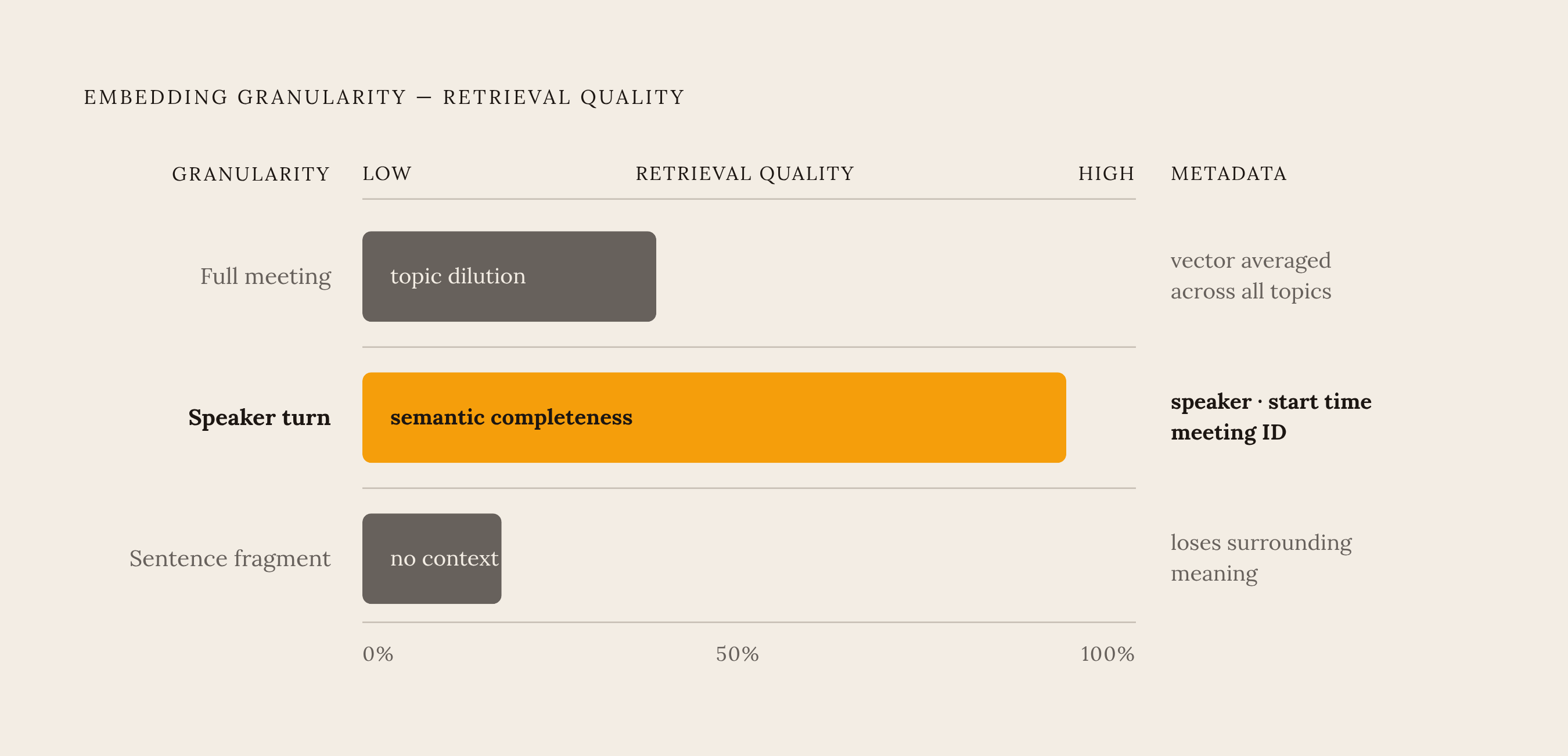
Once the schema is in place, the next decision is what unit of text actually gets turned into a vector. Choose too coarse a unit and a query about pricing will surface an entire meeting where pricing came up once in passing, even if that one mention is buried in an unrelated discussion. But choose too fine a unit, a lone word or a sentence fragment, and no semantic context is left for the embedding model to represent anything meaningful.
The speaker turn sits at the right level of granularity for conversational data. It maps to one person making one coherent statement, which is also the unit a human actually wants to jump to when reviewing a call. Nobody searching a meeting archive wants a fragment of a sentence or an hour of undifferentiated audio; they want the moment someone said the thing they're looking for. Embedding at this level produces the strongest retrieval results in practice because the turn carries semantic completeness for the vector itself while the stored row carries the speaker label and timestamp that make the result something a person can act on.
Embedding a full meeting instead produces a vector that averages across every topic the call touched, which makes the resulting nearest-neighbor comparison diffuse. A query about pricing ends up surfacing meetings where pricing was one topic among many, rather than the meetings where it was the point of the conversation. For unusually long turns, a sales rep delivering a five-minute monologue, a secondary chunking pass that splits on sentence boundaries while keeping the speaker and timestamp metadata attached to each resulting chunk preserves the granularity benefit without losing the surrounding context.
The metadata captured at insert time becomes the payload that makes a retrieved chunk useful once the embedding has done its job: the vector search finds the right turn, and the stored speaker label, start time, and meeting ID tell the application exactly where in the recording to jump. The speaker turn matters as a retrieval unit because it mirrors how people navigate meetings in the first place, a single statement with clear attribution and clear timing. That is why meeting intelligence systems index at this granularity rather than at the meeting or sentence level.
Where keyword-only search breaks down
Keyword search over properly structured segments is fast and exact when a query uses the same words the speaker used. It fails the moment the words differ. A search for "compliance audit" will not match a turn where the actual words spoken were "regulatory review," even though the two phrases mean close to the same thing in context.
Vector search exists to solve exactly that mismatch. Embeddings turn unstructured text into numeric representations placed so that semantic similarity matches proximity in that space, so two turns that express the same idea sit close together as vectors even when their surface wording has nothing in common. A query about pricing objections can surface turns where speakers said "budget," "cost ceiling," "not in this fiscal year," or "circle back next quarter," phrases that share no word with the query itself but carry the same meaning.
But pure vector search has its own well-documented failure at scale. Dumping every historical transcript chunk into a vector database and pulling the top-k matches works cleanly in a small test and degrades once a corpus spans multi-month enterprise timelines: the model starts confusing stakeholder priorities across unrelated calls, and the retrieved context fills with noise that happens to be semantically adjacent but chronologically or organizationally irrelevant.
The production answer combines both approaches. Keyword search handles exact phrases, named entities, and product names, the territory where vector search tends to introduce noise. Vector search handles paraphrased intent and conceptual queries, the territory where keyword search returns nothing. The two retrieval scores get combined at query time. This hybrid approach is also what handles a specific and common enterprise need: searching for a person's name or a product (exact-match territory) alongside the surrounding context of what was said about them (semantic territory), a combination that neither keyword nor vector search handles well in isolation.
To make vector search fast enough to run at this scale, you need approximate nearest neighbor techniques rather than exhaustively scanning every vector in the index, a point the next section takes up directly.
Vector index selection and the memory-latency trade-off in large transcript corpora
Once a corpus grows to thousands of hours of speaker-turn embeddings, the structure of the vector index itself sets how fast a semantic query comes back, whether in milliseconds or in seconds, and whether the infrastructure bill stays sustainable.
HNSW, short for Hierarchical Navigable Small World, is the standard choice for real-time, low-latency queries where accuracy matters most. It builds a layered graph that navigates toward approximate nearest neighbors without scanning the full index, which suits interactive search over transcript segments where a user is waiting on the other end for a result. Product quantization compresses the vector representations themselves to cut memory footprint, a trade worth making when a corpus of speaker-turn embeddings would otherwise demand an impractical amount of RAM, at the cost of some recall.
Neither index is "best" in the abstract. The real decision is which combination fits a given latency requirement and a given memory budget: HNSW on the hot retrieval path for calls people are actively searching, IVF or product quantization compression for the archival portion of the corpus that gets queried less often, and a re-ranking step layered on top of both. Approximate nearest neighbor search trades some recall for speed by design, so a second-pass re-ranker, typically a cross-encoder that scores the query directly against the top-k retrieved segments, can recover precision without a full scan of the index. For a transcript archive growing by thousands of hours a year, that combination of approximate retrieval plus targeted re-ranking is what keeps search both fast and accurate as the corpus scales.
Why naive RAG over transcripts breaks at multi-month enterprise timelines
Standard retrieval-augmented generation, retrieve the top-k chunks, stuff them into the prompt, answer, works reasonably well for questions about a single meeting. It degrades in a specific and predictable way once the corpus spans months: the retrieved chunks increasingly come from different time periods, different stakeholders, and different stages of a decision, and the model starts conflating them.
The failure pattern is concrete. In a multi-month enterprise sales cycle, constraints raised in an early discovery call, an on-premise deployment requirement, a budget ceiling, a specific security objection, need to shape how the system responds to questions asked months later. Flat vector retrieval has no concept of recency or relational structure; it treats a chunk from week one and a chunk from week sixteen as equally current, and the negotiation's actual shape gets lost in the averaging.
The underlying issue is that vector search retrieves whatever matches a query at the moment it's asked. A standard vector store returns relevant chunks at query time, the model reasons over whatever came back, and then it's forgotten the moment the response finishes. Nothing persists between queries. No understanding of entities, constraints, or relationships accumulates call over call.
The architectural response gaining traction adds a structured memory layer above the vector store itself. Instead of retrieving raw chunks every time, the system extracts semantic anchors at ingest time, stakeholder constraints, decisions made, commitments left open, and stores them as structured objects that persist and build on each other across calls rather than being re-derived from scratch on every query. A compiled knowledge layer, sometimes called an LLM Wiki, differs from standard RAG in exactly this way: it synthesizes institutional knowledge between queries instead of reconstructing it from chunks each time a question comes in. That distinction carries real weight for org-wide use cases like onboarding, where a new hire needs context that stays stable and coherent, not reassembled differently depending on which chunks happen to surface. Building that kind of memory layer depends on having the semantic anchors extracted and stored at ingest time, which is the same moment the schema and chunking decisions described earlier are made.
How MCP servers turn a transcript archive into live context for AI tools
A transcript archive, however well indexed, does nothing for an organization if the AI tools people actually use can't query it in real time. Uploading a file gives an AI assistant a single frozen snapshot. You should be able to ask a question today and surface something said last week without anyone having to manually re-upload anything.
The Model Context Protocol, or MCP, is an open standard built for exactly this gap. It lets AI tools such as Claude, ChatGPT on paid plans through Developer Mode, and Cursor, an AI-enhanced code editor, pull live data from external sources instead of depending only on whatever fits in their context window. The standard architecture has three parts: a host application, an MCP client, and an MCP server. For meeting transcripts, the MCP server sits between the transcript store and whichever AI client is asking the question, so it acts as the structured connector between them.
What separates this from a file upload is that the connection stays live. An MCP server lets the AI query transcript data in real time, so it pulls back only the segments relevant to the question actually being asked. Transcripts stop being records sitting in a folder somewhere and start functioning as context an agent can act on directly, in the moment it's needed. Managing the context window is a real constraint here, not an afterthought: dumping entire raw transcripts into a language model degrades reasoning accuracy and slows everything down, so the MCP pattern depends on targeted chunk retrieval and hierarchical summarization to return only what the specific query calls for.
The harder enterprise problem is limiting who can access which meetings. Most meeting tools expose transcripts through MCP only for the individual user's own recordings, which blocks the cross-team queries that make this kind of search valuable to leadership and operations. To solve that, you need an MCP server with authenticated, scoped access across the full organizational transcript index, not just whatever the requesting user happened to record personally. Circleback's MCP connector takes this approach: it authenticates with a user's Circleback account and exposes meeting data to AI assistants and coding agents for any meeting that authenticated user already has access to within the organization, so tools like Claude or Cursor can query decisions and commitments across that whole scope. That turns the transcript corpus into something closer to persistent organizational memory, rather than a collection of separate, siloed personal notes.
Transcription quality as the input constraint that determines whether the vector index is worth building
None of this works if the transcript itself is wrong. Schema design, speaker-turn chunking, hybrid retrieval, MCP delivery, every architectural choice covered here amplifies whatever quality of transcription gets fed into it at the start. A system built on a poorly transcribed corpus produces, in the end, a well-indexed archive of garbage: fast to search, confidently returned, and wrong. Transcription accuracy sets the ceiling on whether building that architecture pays off.