Information Silos Created by Private Meeting Notes
Private meeting notes quietly lock away decisions that colleagues need to make their jobs work.

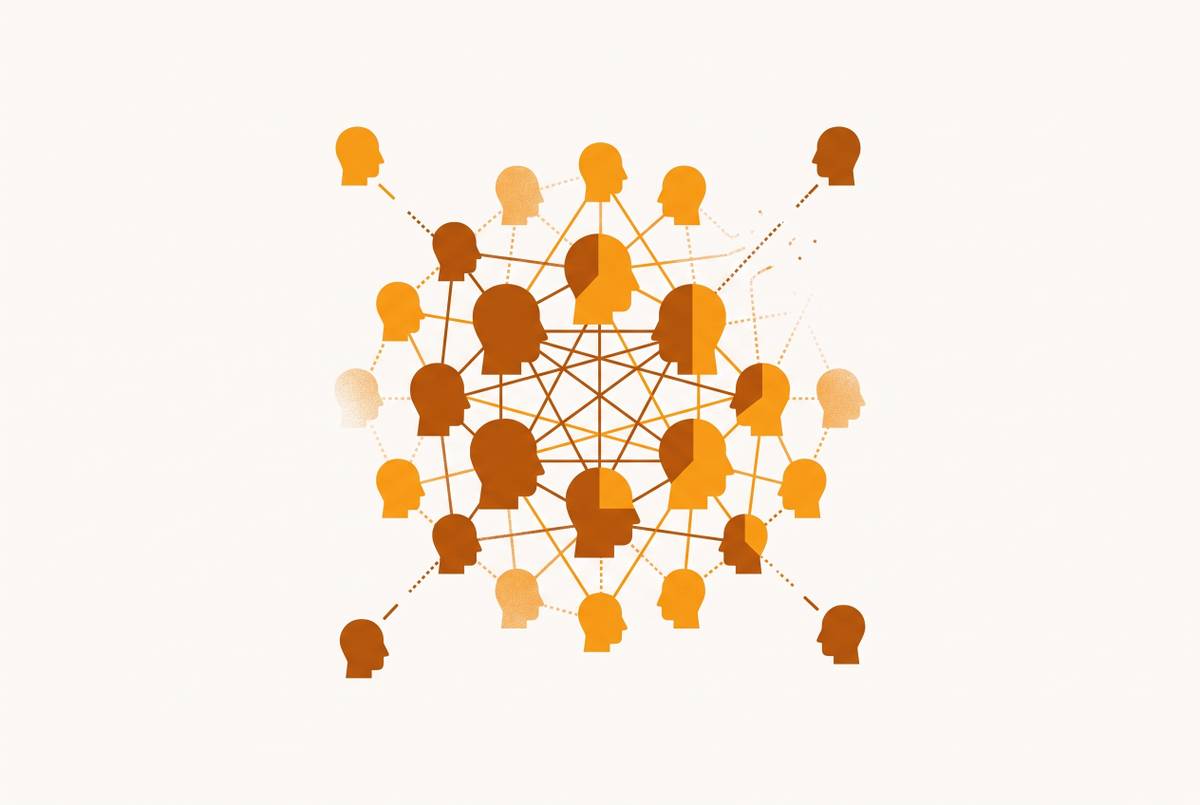
An information silo is knowledge that exists somewhere inside a company but stays out of reach for the people who need it to make a decision or move a project forward. That's the whole definition. It doesn't require bad intent, and it doesn't require a policy that locks information away. Most of the time, it just takes a meeting and a normal human habit: writing something down in a place only one person will ever open.
The mechanism runs like this. Valuable knowledge gets created the moment two or more people talk through a problem out loud, such as a strategy call, a closed-door budget discussion, or a quick one-on-one over a messaging app. Documenting that conversation takes effort. Someone has to type it up, decide what matters, and put it somewhere other people can find. Absent a specific reason to do that extra work, the knowledge stays where it was created, in the heads of whoever happened to be in the room. If notes exist at all, they sit in one person's notebook app or a personal folder nobody else has access to.
None of this happens by design. Nobody decides that decisions made in a Tuesday afternoon call shouldn't reach the rest of the team. But knowledge discussed in closed meetings, in DMs, in one-on-ones, is invisible to everyone who wasn't in the room, functionally identical to knowledge that had been deliberately withheld even though nobody withheld it.
And the standard fix makes the problem worse, not better. Telling employees to "share more" or "loop people in" treats a systems gap as a discipline problem, and that's the wrong diagnosis. There's no shared format for what should get captured in a meeting, no shared location for where notes are supposed to live once they exist, and no norm for who gets access after the meeting ends, or when. Fix one person's habits and the structure still produces the same silo for the next meeting, the next hire, the next team.
What happens to meeting knowledge within 24 hours
Meeting knowledge starts decaying almost immediately. Participants forget roughly 70% of what was discussed within a day of the meeting ending, and whatever ends up in a private notebook was already an incomplete record before anyone closed their laptop. It's a snapshot of what one person happened to retain long enough to write down, filtered through whatever they considered important in that moment, which is rarely what a colleague reading it later would have flagged as important themselves.
That decay is expensive on its own terms. The average professional spends 31 hours a month in meetings, and most of what gets produced across those hours never turns into a form anyone else can use later. Effort goes in. Almost nothing durable comes out.
Private notes don't slow the decay, they compound it. Even the person who took them is working off a partial account, colored by whatever they happened to be focused on instead of what was actually said. Anyone who wasn't in the room doesn't get a worse version of the meeting. They get no version of the meeting.
That gap becomes a real cost in the next meeting. Decisions get relitigated because nobody outside the first room knew a call had already been made. Context gets rebuilt from memory, usually incompletely, and usually differently by each person asked to reconstruct it. Commitments made out loud quietly slip because the only record of them lived in someone's head, or in a notes app nobody else ever opened.
The cumulative cost of knowledge trapped in meeting notes
The scale here isn't anecdotal. Eighty-three percent of survey respondents say information silos exist inside their own companies, and 97% of that group says the silos actively hurt performance. That's close to a consensus among the people doing the work, and it should settle any argument that this is a minor operational nuisance.
Fortune 500 companies lose an estimated $31.5 billion tied to knowledge silos and failures to share information internally. A Forrester Consulting study commissioned by Airtable found employees spend close to 29% of their workweek searching for information they should already have access to, mostly because it's locked inside a silo instead of a shared system. Nearly a third of the workweek, spent hunting for things someone in the building already knows.
That's the aggregate cost of a habit that feels, in the moment, completely harmless: someone takes a private note instead of a shared one.
Where the silo deepens: onboarding, turnover, and cross-team coordination
Onboarding is where the silo becomes visible first. New hires typically need three to six months to grasp the business processes and domain knowledge existing employees carry around without thinking about it, and at enterprise companies that runway stretches to six to twelve months. Some of that time is inherent to learning any new job. A good share of it is worth being angry about.
What new hires are actually missing is context: why the team picked one direction over another, what got tried eighteen months ago and quietly dropped, what commitments got made in rooms they had no way of ever entering. None of that lives in an onboarding wiki, because none of it was ever written down anywhere shared.
Turnover compounds the same failure, only sharper. When an employee leaves, their private notes, the entire record of what they decided, promised, and learned across years of meetings, leave with them. There's no retrieval process, because there was never a shared system to retrieve from. The knowledge doesn't get lost so much as it just stops existing anywhere accessible.
Cross-team coordination breaks for a related reason. A decision made in one team's meeting stays invisible to every other team unless someone actively pushes it outward, and under deadline pressure that push routinely doesn't happen. Two teams build toward incompatible outcomes and only find out once the work is done and the collision is expensive to unwind.
Why individually rational behavior creates collective knowledge loss
Taking a private note is, for the person doing it, the obviously correct choice in the moment. There's no risk of sharing something sensitive with the wrong audience. There's no overhead of reformatting a raw scribble into something a colleague three teams over could actually follow. There's no decision to make about who needs to see it, because the note isn't going anywhere.
That person is optimizing for themselves, in that specific meeting, at that specific time. The cost of the choice doesn't land on them, it lands on everyone who wasn't in the room and has no idea what they're now missing.
This is a textbook collective action problem, the same logic that governs traffic congestion or an overfished lake, applied here to organizational knowledge instead of a physical commons. Everyone does the individually sensible thing, and the group ends up worse off than if nobody had optimized.
Even employees who genuinely want to share run into real friction. Reformatting raw notes so someone outside the meeting can follow them takes time. Figuring out what's relevant to whom takes judgment. Finding the right shared location to put it takes knowing that a right location even exists. Under deadline pressure, all three steps get skipped, because skipping them is faster than doing them.
What organizational memory requires that private notes can't provide
Organizational memory is broadly understood as the knowledge accumulated from past experience that resides in an organization and can be drawn on to make decisions going forward. That's a description of a capability.
A static knowledge base answers one question: where is the document? Organizational memory answers a harder one: what do we know about this, and how has that understanding changed over time? Private notes can't answer either question for anyone who wasn't in the meeting where they were taken, and often can't fully answer it for the person who took them, once enough time has passed.
Real organizational memory needs four things private notes are structurally unable to deliver. Capture means getting knowledge out of people's heads consistently, every meeting, including the ones nobody remembers to write up. Consolidation means processing that knowledge so it connects to related decisions and stays findable in context, rather than sitting as an isolated file. Retrieval means the right piece of knowledge surfaces at the right moment, for someone who wasn't anywhere near the original conversation. Evolution means the record updates as circumstances change, so it reflects current reality instead of freezing a decision made eight months ago as though it still holds.
The most advanced systems in this category go a step further and surface relevant history before anyone asks for it. If a team starts discussing a feature that was already tried and abandoned, a system built for organizational memory can surface the original rationale automatically, without anyone having to remember to go looking for it.
The default AI meeting tools set when they're set up to share
AI meeting note takers change the economics of the problem by removing the effort that makes documentation feel like a tax on top of the actual work. They record the call, transcribe it, and generate a summary automatically, so sharing becomes the path of least resistance instead of an extra step someone has to remember to take.
The mechanics stay fairly consistent across the category. A tool joins or captures the call, transcribes it with speaker identification attached, produces a summary with the key points highlighted, pulls out action items, and syncs the output into project management tools and shared workflows.
Transcription accuracy has mostly stopped being the differentiator. The strongest tools now hit 90 to 95% accuracy or better in English, with the best models climbing above 95% on clean audio and dropping to something like 85 to 90% in messier multi-speaker settings with crosstalk and heavy accents. That's good enough for most working purposes, which means the real competition has moved elsewhere, into what happens to the output after it's generated.
The default result from a modern tool is no longer a wall of raw transcript someone still has to comb through. It's a structured summary: an executive overview, a list of decisions, action items assigned to names, and, for sales-specific tools, fields formatted to drop straight into a CRM. That structure is what actually breaks the silo, since the output is built to be shared from the moment it's generated, not reformatted for an audience after the fact.
A factual comparison of tools that route meeting knowledge into shared workflows
The right test for any tool in this category is not just transcription quality. It's whether the tool routes what happens in a meeting into a system other people can actually reach, or whether it just digitizes the same private note and calls it progress. Most vendors in this space compete on the wrong metric.
Fellow treats a meeting as a workflow to manage rather than a recording to transcribe. It covers the full lifecycle: structured agendas set up before the meeting happens, accurate transcription and automatically generated notes during it, and an AI agent that follows up on commitments afterward. Meetingnotes.com named it the strongest all-around AI note taker for teams, and The New York Times Wirecutter picked it as a top choice for transcribing and summarizing meetings. Pricing starts at $7 a month, and it's built for meeting management across teams, with task creation included. Because the output is structured for sharing from the start rather than cleaned up after the fact, Fellow sits closer to the organizational-memory end of this category than tools built purely around transcription, and that positioning is the reason it belongs at the top of this list.
Fireflies.ai prices its plans at $18 a month for Pro and $29 a month for Business, and layers in auto-recording, automatically generated summaries, sentiment analysis, topic tracking, and direct integration with CRM and other business platforms. It runs at roughly 93% accuracy in English and supports more than 100 languages. It works by sending a visible bot, called the Fireflies.ai Notetaker, into the meeting as a participant, and some attendees find that intrusive; teams should flag it before rolling this out to client-facing calls. Its strongest case is CRM integration, which pushes meeting content directly into shared sales workflows instead of leaving it stranded in a transcript.
Fathom offers the most generous free tier in the category: unlimited meeting recording and transcription with no monthly cap. It covers Zoom, Google Meet, and Microsoft Teams, runs at around 94% accuracy in English, and offers a paid Team Edition. It connects with a range of other tools, though its summaries are built mainly for post-meeting automation rather than deeper workflow structuring. The unlimited free tier lowers the barrier for a whole team to standardize on one shared system instead of drifting back to private notes, and the botless option removes friction in client settings where an obvious recording bot would land badly.
None of these tools eliminates the underlying discipline a company still needs. A shared location, a shared format, a norm about who gets access once a meeting ends, all of that still has to exist. What changes is the cost of getting there. When capturing and structuring a meeting takes no extra effort, sharing happens by default instead of remaining the exception someone has to remember to make.