Structured Exit Interviews as Institutional Memory Capture
Organizations lose critical operational knowledge when departing employees leave.

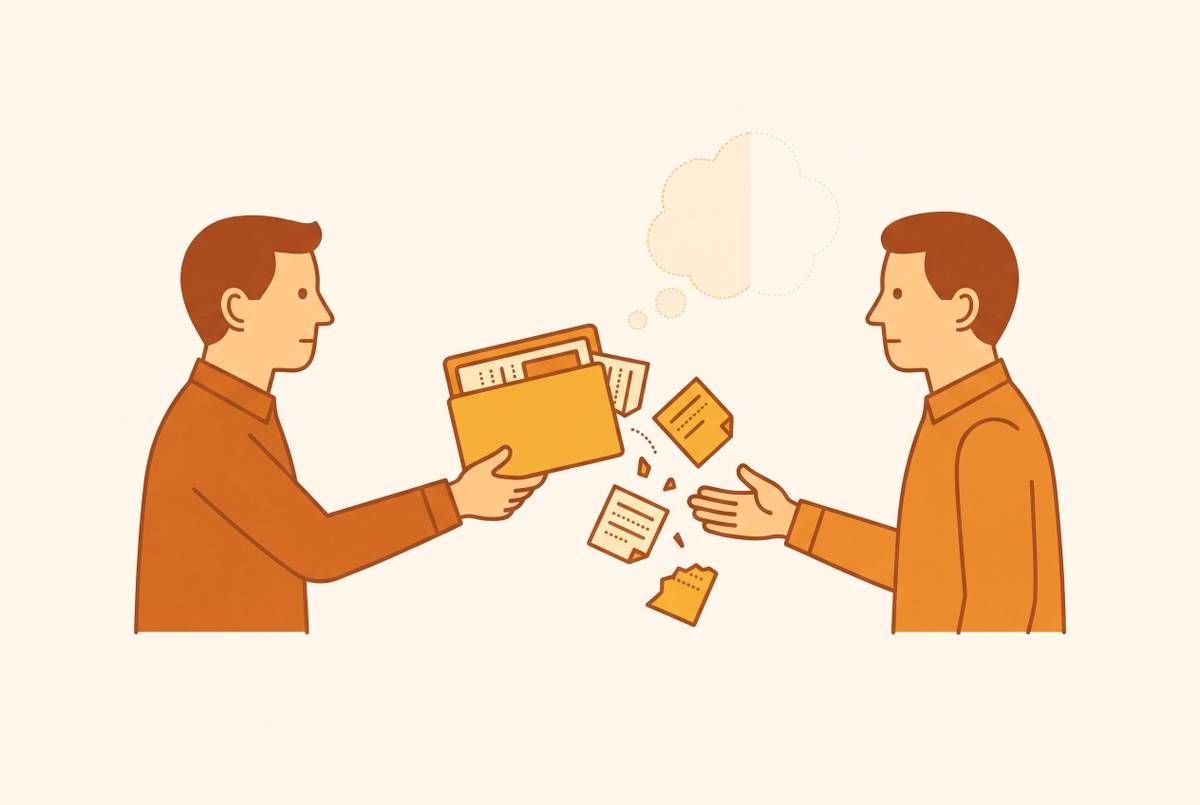
A fifteen-year employee gives notice on a Monday and is gone within two weeks, and with her goes the list of three people she always called when a particular vendor system threw an error no manual explained, the workaround she built for a reporting quirk nobody else knew existed, and the judgment call she made every time two warning signs appeared together that told her, long before a dashboard would, that a client was about to walk. None of that leaves a trace in her exit interview, because her exit interview was never built to capture it. It was built to measure why she left, how she felt about her manager, and whether HR and security had checked the boxes required to close her file.
Those three goals, understanding departure reasons, gathering feedback on leadership and culture, and completing compliance requirements, are legitimate and worth pursuing on their own terms. Retention analytics genuinely help organizations spot patterns in attrition and respond to them. The trouble is that a structure optimized for those three goals differs from the structure needed to extract the operational knowledge a successor, a frontline supervisor, or an AI assistant would need to keep performance steady after she's gone. A satisfaction survey and a knowledge-transfer interview ask different questions, need different interviewers, and produce different kinds of output; treating them as the same event means the second one never happens.
The reluctance to be candid makes the gap worse. An HR representative sitting across the table, with a reference check still pending, creates exactly the conditions under which a departing employee softens or omits the truth, both about why they're leaving and about what actually goes wrong in the role day to day. The most preventable departures, the ones caused by a difficult manager, are also the ones least likely to get named honestly in that room. The same social pressure that suppresses honest departure reasons suppresses the admission that the SOP is wrong in three places or that a workaround everyone depends on was never approved. Fixing the design flaw and fixing the reluctance to be candid turn out to be the same project.
The three layers of knowledge at risk
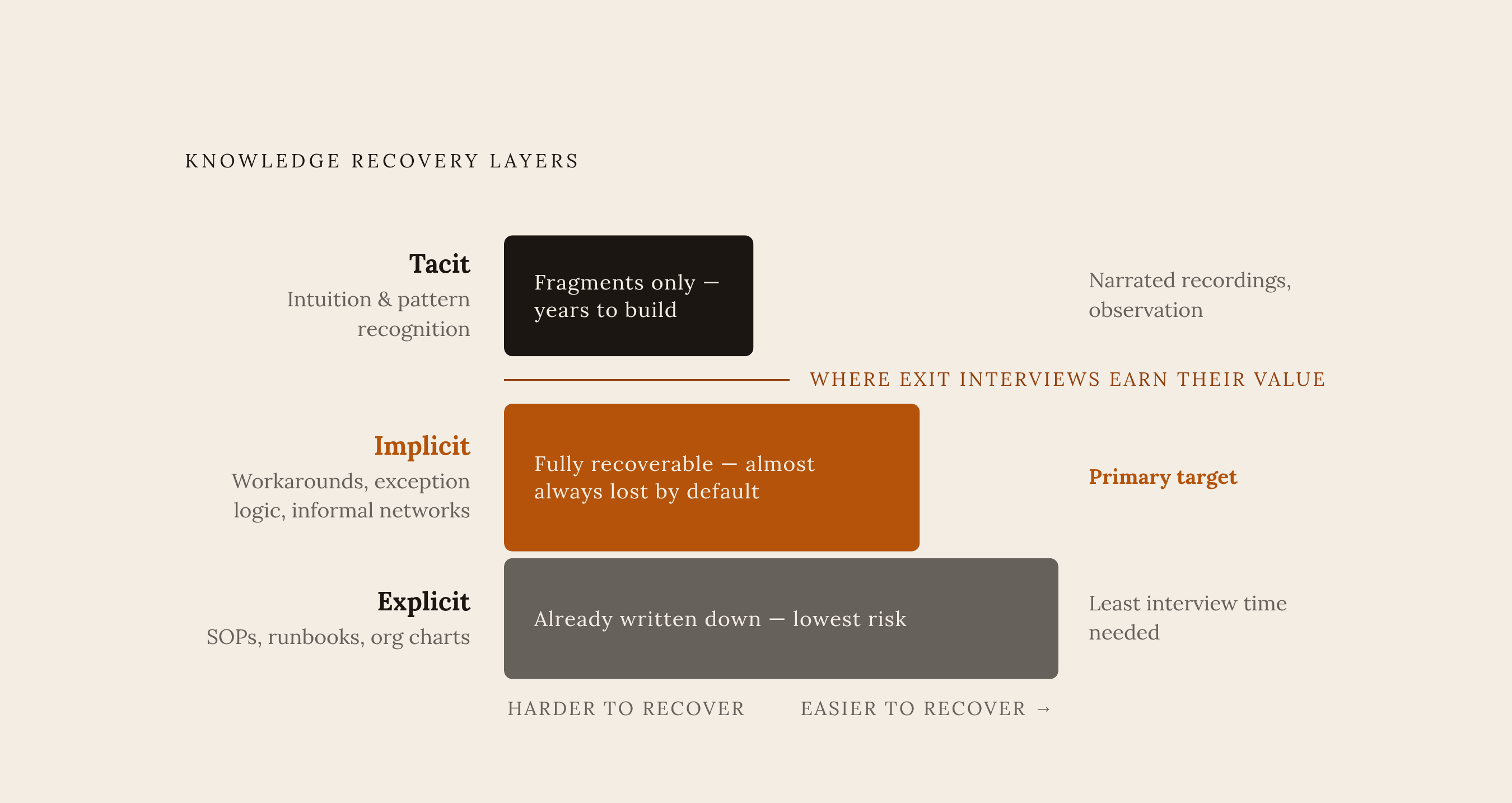
Not everything a departing employee knows is equally hard to recover, and sorting it into layers is the first step toward building an interview that actually captures the right one.
Explicit knowledge is whatever has already been written down: standard operating procedures, runbooks, org charts, policy documents. It's the lowest-risk layer because it already exists somewhere outside the employee's head, and it deserves the least interview time. Spending a scarce thirty or sixty minutes confirming facts that live in a shared drive is time not spent on knowledge that will otherwise vanish.
Implicit knowledge is the layer the interview should target. It's everything the employee could write down if someone asked the right question, but never has, because no one ever asked and the job never required it. Workarounds built to route around a broken process, exception-handling logic for the cases that don't fit the manual, the informal network of who actually answers questions about a niche system, all of this is extractable through the right questions and the right follow-up, and it's the layer where a well-structured exit interview earns its value. Which dashboards an expert trusts over the official reporting tool, which shortcuts are safe and which are red flags, and what questions an expert reflexively asks before signing off on a decision all live here.
Tacit knowledge is harder. It's the intuition built over years of repetition, the pattern recognition that lets someone sense a problem is about to escalate before any metric shows it, the feel for a situation that resists being put into words even by the person who has it. Tacit knowledge surfaces best through observation, shadowing, or recording someone in the act of doing the work, not through a single sit-down conversation, though a well-framed interview question, something like what would break within the first few months if you left tomorrow, can pull fragments of it into view by anchoring the conversation to a concrete consequence rather than a general reflection.
What a knowledge-transfer exit interview asks
A knowledge-transfer exit interview does not need dozens of questions. It needs a small number built around a single organizing idea: capture the moments and the moves that matter, the points in the job where an expert's judgment changes the outcome and the moves a novice wouldn't think to make.
That means asking about the high-risk steps and failure-prone handoffs where judgment materially affects safety, quality, or a customer's experience. It means inviting the employee into the specific territory where the official process runs out, prompting for the moment when they'd say this isn't in the guidebook, but here's what they actually do. It means asking how they notice a problem before it's visible to anyone else, and how they decide, in the moment, what needs fixing now, what can wait, and who needs to be looped in.
A handful of question categories cover this ground reliably. Questions about failure and exception patterns reveal what the documentation misses: when people follow the SOP literally, they reveal what tends to get missed, and what to expect when A and B happen at the same time. Questions about the informal network reveal who holds knowledge no org chart reflects: who do you call for a niche issue that isn't written down anywhere, which team has quietly built a better way of doing the same work. Questions about onboarding gaps surface where new people get stuck first and what the departing employee says or does to get them unstuck. Questions about undocumented constraints surface the considerations that shaped a major decision but never made it into any record. And a direct question about workarounds, which ones exist that no one else knows about, and which of those are safe to keep using versus which are risks waiting to surface, gets at the exact material that lives only in that one person's head.
Framing the legacy prompt around operational risk rather than personal reflection, what would break within the first few months if you left tomorrow, does more work than it first appears to. It turns the conversation away from sentiment and toward the concrete, and it gives the departing employee a frame that makes the stakes of their answer obvious.
None of these questions work on their own without follow-up. A fixed script that stops at the first answer produces high-level reflections that are nearly impossible to turn into onboarding guidance or AI-ready content. The actual value sits in the second question, the one that follows up on a vague mention of the handoff with what specifically goes wrong there, and that kind of probing is a skill, not a checklist item someone can tick off. It requires noticing when an answer gestures at something important without naming it, and asking again until it's named. That requirement, more than any single question on the list, determines who should be running the interview.
Why the interviewer format determines whether the right knowledge surfaces
The same question, asked by two different interviewers under two different conditions, produces two different answers. That makes the choice of interviewer a structural design decision, not an administrative detail to settle after the questions are written.
Human-led exit interviews carry a built-in candor gap. An HR colleague in the room, combined with a reference check still pending, pushes departing employees toward softened or incomplete answers, and the departures most worth understanding, the ones driven by a difficult manager, are the ones least likely to get named honestly under those conditions. Perspective AI documents a specific mechanism for closing that gap: an AI interviewer removes the social pressure of a known colleague sitting across the table, asks the same probing follow-up questions consistently rather than inconsistently depending on who's conducting the interview that week, and is available around the clock without the scheduling friction of a calendar-bound meeting.
That consistency matters for knowledge transfer specifically, not just for retention analytics. Adaptive follow-up, delivered the same way every time regardless of who's leaving or how senior they are, and without a visible reaction that might make a departing employee second-guess an admission, raises the odds that the implicit knowledge from the previous section actually gets named rather than glossed over. Perspective AI's recommended playbook wires the interview directly into the offboarding workflow so it fires automatically the moment a resignation is logged in the HRIS, and removing that scheduling friction is a primary reason participation rates run higher than they do for interviews that depend on finding a mutual slot on a calendar.
None of this makes the human interviewer obsolete. The practical best practice for most organizations is a hybrid model: an AI-conducted conversational interview as the default for every departure, paired with a human or third-party interviewer reserved for senior leadership exits and for any departure that's legally or culturally sensitive enough to warrant a person in the room. For roles where tacit knowledge is the central concern, senior technical experts, long-tenure client relationship holders, the exit interview benefits from being supplemented while the employee is still on staff, through a recorded working session or a narrated screen walkthrough that captures more than the conversation alone can. UVM's knowledge-capture guidance captures the economics of this well: having an expert perform a task while recording and narrating it turns a 40-hour writing project into a 30-minute recording session that AI can then structure into something usable.
AI Transcription and Note-Taking as Structured, Reusable Knowledge
Running the right interview, with the right questions and the right interviewer, produces raw material of real value. It becomes organizational memory only once that material is transcribed accurately, structured intelligently, and stored somewhere a successor or an AI system can actually use it.
Real-time transcription removes the first bottleneck, which used to be the hours required to manually process a long conversation before anyone could act on it. Once a conversation is transcribed, AI identifies key themes, decision points, and exception patterns in something close to real time, instead of an analyst reading through every transcript line by line to find what matters. UVM frames this as solving a scaling problem specific to departing experts: traditional documentation methods cannot capture decades of accumulated experience inside a two-week notice period, and transcription paired with automated theme extraction compresses a process that used to take far longer than any departing employee has left to give.
What good transcription enables downstream is what makes the whole exercise worth running, starting with a structured "wisdom guide" that can be built for new hires directly from the legacy interview. Searchable knowledge bases let a successor type a plain-language question and retrieve the specific expert insight relevant to it, without needing to know which document to open. Tagging by role, task, process step, context, and risk level turns an hour of conversation into something that can be filtered and surfaced on demand.
Jargon and internal terminology make accuracy harder to achieve here than in a typical meeting transcript. Domain-specific jargon, internal product names, and technical terminology trip up generic transcription models, and support for custom vocabulary and glossaries is a practical requirement for this kind of enterprise knowledge capture, not an optional extra. Structure matters as much as raw accuracy: the useful output of an exit interview is not a transcript but a structured artifact, organized into themes, decision points, exception patterns, informal relationships, and named risks, built in a form that can feed onboarding flows, AI assistants, and successor playbooks directly. Organizing captured knowledge by role, task or process step, context, and risk level is what lets an organization build onboarding content targeted to a specific job, and lets guidance surface at the moment someone actually needs it. NLP-driven sentiment analysis, applied to exit interview text and trained on domain-specific HR data, can identify primary departure reasons with meaningful accuracy, though sarcastic, ambiguous, or mixed-emotion responses still need a human reviewer to interpret correctly.
Routing Structured Output into Organizational Memory
Capturing knowledge and routing it are two separate jobs, and an interview transcript sitting unused in a video file or a note-taking app has not actually preserved anything. It becomes organizational memory only once it reaches the systems and the people who will need it.
The clearest path is direct integration into the successor's onboarding. Exit interview output should feed onboarding not as a generic document dump handed over on day one, but as targeted content linked to the specific tasks, exception types, and decision points the new hire will actually run into. UVM's guidance points at a concrete version of this: upload the retiring employee's project archives and let AI tag and categorize the content so a future employee can ask a plain-language question and retrieve the relevant answer directly, without searching through folders hoping to find the right file.
This matters because weak onboarding compounds the knowledge loss that already happened at departure. Work Institute data shows roughly 37.9% of new hires leave within their first year, and broader estimates from Gallup and SHRM put the share lost within twelve months as high as 67%. Every one of those early departures repeats the original loss: institutional knowledge disappears when the expert leaves, and disappears again when the replacement who was supposed to absorb it doesn't stay long enough to do so.
AI-powered knowledge management systems close part of that loop by ingesting unstructured content, transcripts, notes, narrated recordings, and organizing it into a resource a successor can search without needing to know in advance where the answer lives, only what question to ask. Retrieval-Augmented Generation makes that search contextual rather than keyword-based: an employee asks a question in plain language and gets an answer grounded in expertise that someone else captured before they ever needed it. Treated this way, the exit interview becomes the first entry in a system built to outlast any single person who leaves it.