How Meeting Notes Become Auditable Business Records
Accurate notes aren't legally defensible without tamper-proof records.
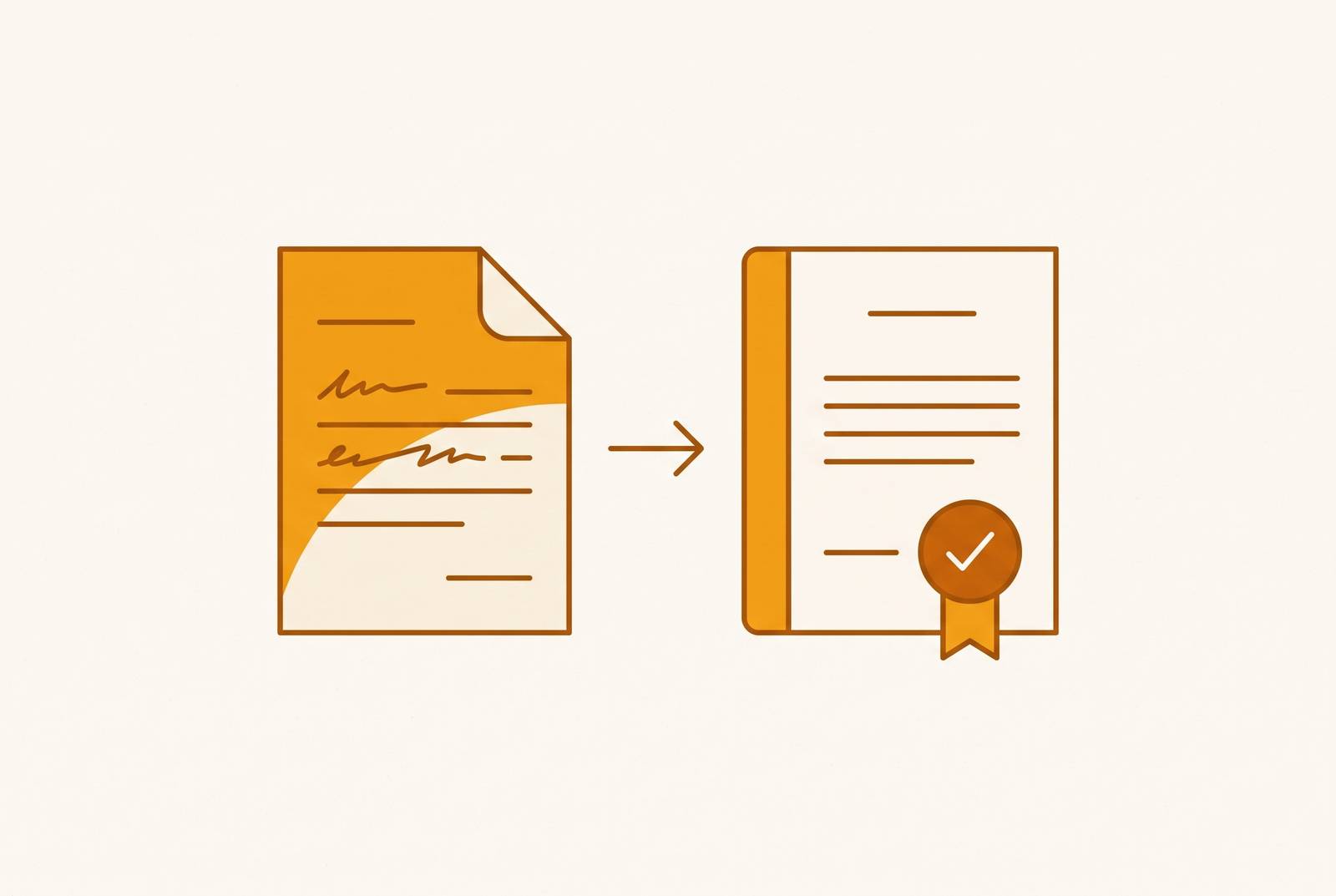
A company facing an employment dispute pulls its AI-generated meeting notes expecting them to settle the question of what was promised and when. Instead, opposing counsel asks a simple question none of the notes can answer: can anyone show this document hasn't been altered since the meeting ended? The notes were accurate. The notes were useless as evidence, because accuracy and auditability are not the same property, and most teams build systems that optimize for the first while assuming they've gotten the second for free.
The meeting intelligence category has split into two distinct architectures. Neither architecture produces an auditable record on its own. Both require deliberate configuration to get there, and most deployments skip that configuration entirely because the tools work well enough day to day that nobody asks what happens when a record needs to hold up under scrutiny.
So what separates a usable note from a defensible record? It comes down to four questions. Was the record changed after it was captured, and would anyone be able to tell? Who said what, with enough confidence to support a decision built on it? When, where, and under what circumstances did the exchange happen, in terms specific enough to retrieve the record later under a legal hold or an audit? And can the record's path from the moment of capture to its final storage location be traced without gaps? Those four questions map to four properties: immutability, attribution, structured metadata, and chain of custody. Each one is a separate engineering and governance problem, and each is the subject of its own section below.
Immutability: what it means for a meeting record to be tamper-evident
Immutability means that every change made to a record after its initial capture gets logged with a timestamp and the identity of whoever made it, so the original version and every edit that followed remain visible and distinguishable from one another. A record can still be edited and remain immutable in the sense that matters: what's lost, and what breaks auditability, is silent editing that leaves no trace.
Most AI meeting tools don't work this way. A summary sitting in a Google Doc six months after a meeting looks exactly the same whether it's untouched or whether someone went in and rewrote a sentence last week. There is no structural way to tell the difference, and that indistinguishability is the whole problem. A record that can't prove it wasn't altered carries no more evidentiary weight than a verbal claim.
Building real immutability into a meeting capture pipeline takes a few concrete choices. The raw transcript needs to be written to storage the moment it's captured, separate from any summary or edited version that gets produced afterward, so there's always an unaltered original to check against. The raw transcript is the anchor for all of this. Summaries are derived from it and can be legitimately rewritten, condensed, or corrected over time, but the transcript that produced them has to stay fixed at the moment of capture. A system that only keeps the summary and discards the transcript has no immutable layer at all, no matter how polished the summary looks.
Attribution: why speaker labels are a legal and operational requirement, not a convenience feature
Knowing that something was said in a meeting means little if nobody can say who said it. A record that can't attribute statements to specific people can't support a compliance finding, an employment decision, or a claim that a contractual term was agreed to. Attribution is what turns a transcript from a loose description of a conversation into something closer to testimony, and testimony without a named speaker carries no weight in any forum that matters.
Attribution relies on speaker diarization, which is the automated process of detecting and labeling distinct voices in an audio stream. Clean, single-speaker, studio-quality audio is a different problem than real meeting audio, so models built for one don't automatically transfer to the other. Overlapping speech, two people talking over each other, a common occurrence in any meeting with more than two participants, causes words to get merged into a single utterance or attributed to the wrong speaker.
These aren't cosmetic errors. None of this means AI-driven attribution is unusable. So if you're building for auditability, you need to design around the specific conditions where attribution fails. In practice, that means using individual headset or close-microphone audio rather than relying on a laptop's built-in microphone or a speaker sitting in the middle of a conference room table. It means linking speaker profiles to calendar identities and email addresses rather than settling for generic labels like "Speaker 1" and "Speaker 2," which carry no verifiable link to an actual person. And in legal, HR, or compliance contexts, where the cost of getting attribution wrong is high, it means adding a human review step before any attributed statement gets written into a system of record.
Structured metadata: the difference between a searchable record and a retrievable one
Attribution and immutability both deal with the content of a record, what was said and who said it. Metadata deals with context: when the meeting happened, where, who attended, what it was about, and what project or deal it connects to. If that context isn't attached, you can't reliably pull up a meeting record during a legal hold, a regulatory inquiry, or an internal audit. The record might exist somewhere on a server, but if nobody can filter for it by date, participant, or topic, it functions the same as if it didn't exist.
AI meeting tools differ widely in how much metadata they capture and, more importantly, where they write it. Tools that connect natively to a CRM, or that route through a middleware connector like Zapier, write structured fields directly into the CRM record: attendees, date, deal stage, linked contact. Tools that instead drop a summary into a Google Doc leave all of that same information sitting as unstructured prose, with no fields to query. Dedicated sales call recorders tend to sit in between: they log that a call happened at the activity level, but they don't typically auto-populate deal stage, follow-up tasks, or contact records without someone configuring that connection first.
The schema matters as much as whether metadata exists. If you want to get this right, you need to map the output fields your meeting tool produces to the specific structured fields inside your actual system of record, rather than accepting whatever default export format the tool ships with.
Chain of custody: verifying that a record traveled intact from capture to storage
Chain of custody asks a different question than the first three properties combined: can anyone demonstrate that the transcript sitting in the system of record today is the same document that was captured at the moment the meeting happened, with no undocumented stop, transformation, or access event anywhere along the way? This is where immutability, attribution, and metadata all become vulnerable at once, because even a perfectly tamper-evident, correctly attributed, fully tagged record is worthless if nobody can show it arrived intact.
Modern AI meeting workflows create several points where custody can break. The meeting platform captures audio and sends it off to a transcription engine, and if that transmission isn't logged, there's no record of what left the platform or whether it matches what arrives downstream. A middleware connector transforms and routes that output along the way, and if the transformation itself isn't logged, the record that lands downstream can't be traced back to the original source with any confidence. Wherever the note finally lands, a CRM field, a Slack channel, a project tracker, that destination carries its own access controls and its own audit logging capability, and those capabilities are rarely consistent from one destination to the next.
The Model Context Protocol, introduced by Anthropic in November 2024 and adopted by OpenAI in March 2025, has become a significant integration layer connecting meeting data to AI assistants, and it raises its own custody questions. Who has the authority to set up an MCP integration that exposes meeting data to an external AI system? How are permissions granted and constrained at the protocol level? How are MCP servers themselves authenticated and trusted? So you may need to move governance that used to live at the application layer down to the protocol layer, to get consistent enforcement across every integration a team runs. To meet the bar for chain of custody, you need to log every API call at every integration point with a timestamp and an actor identity, keep access logs at each destination system that record who read or modified the record after it arrived, and enforce a data retention and deletion policy automatically rather than leaving it to someone's manual judgment call.
Consent and recording law as prerequisites, not compliance afterthoughts
None of the four structural properties matter if the recording itself was never lawful to make. A meeting record built on an unconsented recording is evidence of a legal violation, and no amount of immutability, attribution, metadata, or custody logging can retroactively fix a record that was unlawful to create. Consent has to be settled before capture begins, not treated as paperwork to clean up afterward.
Geography complicates this more than most teams expect. Under the California extraterritorial doctrine, established in Kearney v. Salomon Smith Barney in 2006, California's all-party consent requirement follows any California-based participant into a call even when every other participant is sitting in a one-party consent state. So a single California attendee can impose the stricter standard on the entire conversation regardless of where the meeting was organized or hosted, which creates asymmetric exposure for any distributed team running meetings across state lines.
Professional practice regulation is catching up to the same set of concerns. The New York City Bar Association's Professional Ethics Committee issued a formal opinion dated December 22, 2025, addressing how AI recording, transcription, and summarization tools affect audio and video calls between attorneys and their clients. A follow-up opinion, Formal Opinion 2026-2, extended those same principles to conversations with co-counsel, prospective clients, opposing counsel, witnesses, and employees or agents of the attorney, such as investigators. The EU AI Act adds a further layer for any team using AI notetakers in recruitment or employee monitoring contexts, where the tool may be classified as a high-risk AI system and trigger obligations well beyond standard GDPR compliance. And if a notetaker processes voice data to build a speaker-identifying voiceprint, that can trigger state biometric privacy statutes, Illinois's BIPA being the most heavily litigated example, unless notice and consent are obtained before the processing starts. The practical takeaway for any team configuring a capture workflow is to build disclosure language, notification banners, and opt-out mechanisms directly into the meeting invite or the capture tool itself, so consent is settled before the recording starts rather than handled inconsistently by whoever happens to be running the meeting that day.
Configuring a meeting capture system for all four properties
Picking the right vendor won't get all four properties into place on its own. It takes a series of deliberate decisions across capture, storage, integration, and governance that most teams never make explicitly, because the default settings on most tools quietly skip past every one of them.
At the capture layer, audio quality sets the ceiling for everything that happens downstream: individual headset microphones produce meaningfully lower error rates than room or laptop microphones, and that gap appears directly in attribution reliability. Teams also need to pick, deliberately and consistently, between bot-based capture that joins a call visibly and silent desktop recording that doesn't, because each carries a different consent disclosure requirement and a different audit surface. Raw transcript storage needs to be kept separate from any summary or edited output and written to a tamper-evident or append-only store the moment it's captured.
At the attribution and metadata layer, speaker profiles should be linked to calendar identities and email addresses rather than left as generic generated labels, so that attribution in the final record ties back to a verifiable person. Metadata fields, date, attendees, platform, linked deal or project, topic classification, belong in structured fields in the destination system. Tools that connect to CRMs like HubSpot, Salesforce, and Attio, or to project tools like Linear and Asana, support that kind of structured field mapping directly; tools that only produce a Google Doc do not.
At the integration and custody layer, every connection point, native connector, middleware, API, MCP server, should log its API calls with timestamps, and teams should periodically audit their own integration stack for transformation steps that aren't being logged anywhere. MCP connectors that expose meeting data to AI assistants like Claude, ChatGPT, or Cursor need explicit permission scoping and authentication logging built in at the protocol level. Destination systems each carry their own access control and audit logging capabilities, and the weakest one in the chain sets the limit on how auditable the whole chain actually is.
At the governance layer, consent disclosure belongs in the meeting invite or the capture tool's own notification mechanism, not left to individual employees to handle case by case. Retention and deletion policy should run automatically, so nobody has to remember to clean up old records. And in legal, HR, or compliance contexts, a review step before an attributed statement enters the system of record is worth the time it costs, because the cost of a misattribution in those contexts is far higher than the cost of the review itself.
With all four properties in place, a meeting record functions as organizational memory: searchable across the full history of a team's meetings, queryable by AI assistants built on top of that history, and solid enough to settle a dispute when someone's recollection of a meeting doesn't match what the record shows.