Audit Trails for Regulated Industry Decision-Making
Regulators now require documented proof of human deliberation behind AI-assisted decisions.
Three regulatory events converged in 2026 to turn AI audit trails from a governance nicety into an enforceable obligation. Any organization whose AI systems touch financial reporting, protected health information, or regulated banking decisions is now expected to produce a record that can be reconstructed and defended, not just a summary that sounds plausible after the fact. In March 2026, the SEC stood up a dedicated SOX enforcement group aimed at auditor misconduct and violations of SOX auditing standards, a move that signals less patience for internal control failures anywhere AI has touched a financial process. Standing HIPAA requirements around protected health information and the EU AI Act's obligations for high-risk systems complete the picture: the standard is consistent across sectors, and regulators are willing to enforce it.
Where regulated decisions originate
The exposure most regulated organizations carry has little to do with AI models making undocumented decisions. The deliberation and commitment that precede AI-assisted action happen in meetings, and meetings are the one part of the decision chain that almost nobody treats as a records system. Consider a credit committee weighing whether to approve an underwriting exception: the AI model scores the applicant, but the reasoning that actually justifies the exception lives in the conversation among the people in the room, not in the model's output log. Consider a compliance officer who approves a deviation from standard procedure out loud, on a call. That verbal approval is the regulated event, and no system anywhere captures it. Regulators have started treating a missing decision trace as a books-and-records violation, and a decision that can only be traced to a model's output, with nothing showing the human deliberation that actually authorized it, counts as a missing decision trace. Most organizations have spent years building logs of what their AI systems do. Far fewer have built any equivalent record of what their people decide, and in regulated industries, the human decision is usually the one that has to hold up under examination.
What a compliant meeting record must capture
Regulators already apply a 12-field minimum schema to evaluate AI-influenced decisions, and that same schema maps directly onto what a meeting record needs to contain. Most meeting records, even the ones generated by AI transcription tools, are missing at least half of those fields. A usable record needs to show who was actually present, authenticated as specific individuals. It needs to capture what inputs informed the discussion, whether that's a transcript segment, a document shared on screen, or a model's prior recommendation that the group was reacting to. It needs a timestamped account of what was decided and by whom, not a paraphrased summary that smooths over who actually said yes. It needs the model version or decision engine involved, if an AI system's output shaped the conversation, so that a later reviewer can tie the discussion back to the exact tool that produced the recommendation under review. And it needs an explicit record of the outcome: what action was authorized, and what wasn't. A meeting tool that produces a readable summary for a salesperson's inbox is solving a different problem than one that produces a structured, field-level record a compliance team can reconstruct months later. Traceability means being able to rebuild the full chain from prompt to model to output to action. Logging that a meeting happened, and that something was generally agreed to, does not meet that bar.
Retention floors and the default deletion problem
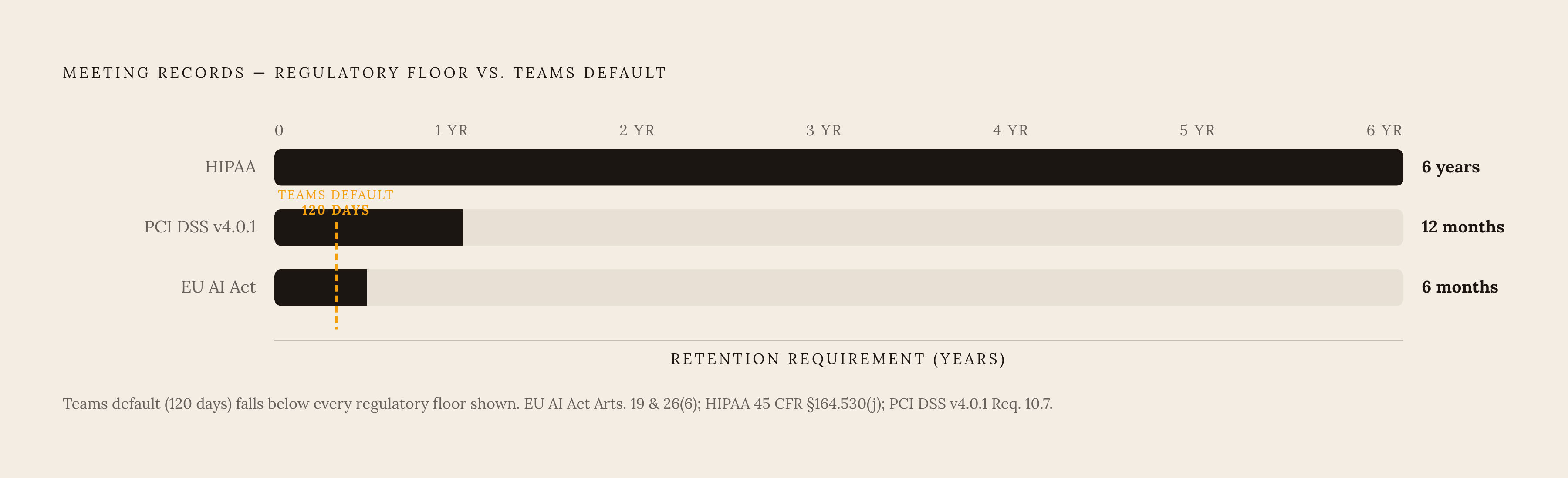
Capturing the right fields at the moment of the meeting solves only half the problem. If the record gets deleted before the applicable regulatory floor, the entire capture effort is worthless exactly when it matters most, during an examination. The floors vary by regime, and they are specific. HIPAA requires six years of retention. PCI DSS v4.0.1 requires twelve months of retention, with three months of that immediately accessible. The EU AI Act, under Article 26(6) for deployers and Article 19 for providers, sets a floor of at least six months for high-risk AI systems. Microsoft Teams' documented default expiration for meeting recordings and transcripts is 120 days, well short of HIPAA's six-year floor and arguably short of PCI's twelve-month minimum depending on configuration. That gap sits invisibly in the background during normal operations and becomes a serious problem the moment an examiner asks for a record that no longer exists. EU AI Act penalties for non-compliant high-risk systems and GDPR fines, which can reach €20 million or 4% of a company's total worldwide annual turnover (whichever is higher), give a sense of how costly that gap can be. The practical fix is retention settings configurable by regime. A healthcare provider handling HIPAA-covered clinical conversations alongside PCI DSS-covered payment calls cannot run a single deletion policy across both data sets and expect either one to hold up.
The individual-attribution gap that breaks every other control
Picture a vendor payment approved through a workflow that posts updates via an API key, with no record of which person actually signed off. That failure mode is more common than most compliance teams realize, and it is the single most frequently failed field in enterprise AI audit trails: authenticated human user identity. When a meeting intelligence tool pushes a summary or an action item into a CRM or another system of record using a service account or an API key, and nothing logs which human directed that action, the individual-attribution requirement collapses across HIPAA, SOX, and GDPR all at once. HIPAA's unique user identification rule requires that every access to protected health information trace back to a specific natural person. A uniquely identified service account can satisfy the letter of that rule, but it doesn't, by itself, tell an examiner which human was behind the access. SOX carries its own version of this requirement for financial controls, and a credit committee summary that triggers a deal-stage update in a CRM is touching a financial control whether anyone labels it that way or not. "The meeting tool did it" does not survive a walkthrough with an auditor. This gap is most visible at integration boundaries, where a meeting tool hands its output to another system. A meeting tool typically does capture the authenticated identities of the people in the room. The trouble starts the moment the output leaves that system through a webhook or an API call, headed for a CRM or a case management system, because the identity information has to travel with the content, not just the content itself. The architectural fix is a correlation-ID design, where every downstream action carries a reference back to the human session that authorized it, so a reviewer can always walk the chain backward from a CRM field change to the specific person who approved it in the original meeting.
The meeting record and the broader AI decision chain
A compliant meeting record is one link in a longer chain that has to connect backward to the data and models that shaped the discussion and forward to every system-of-record action the meeting set in motion. That chain has three parts. Upstream sits the AI model's inputs, outputs, and version at the moment it produced whatever recommendation the humans were reacting to, captured in the model's own audit trail. The meeting itself sits in the middle: who attended, what was said, what was decided, what got approved, captured in the structured record described earlier. Downstream sits every action the meeting authorized: CRM field updates, new tasks, escalation routing, approval postings, each one carrying the meeting record's decision ID as the reference that justifies it. In financial services, this chain has a specific destination: the meeting record needs to map to the financial assertion it supports and the transaction or journal entry it authorized, so that an AI-generated summary feeding into a credit decision appears inside the decision chain itself instead of sitting unlinked in someone's inbox or a CRM activity feed. In healthcare, the meeting record of a clinical consultation or an override of a diagnostic AI's recommendation needs to link directly to the patient record and to the AI output that prompted the discussion. A summary sitting in a separate tool, disconnected from both, fails the chain-of-custody test regardless of how well it was written. Deploying AI agents without documented compliance measures creates real legal exposure, and regulators are increasingly treating weak AI governance the same way they treat weak cybersecurity controls: as a control failure in its own right. A broken decision chain is simply what an undocumented compliance measure looks like in practice.
What the routing layer must deliver
The workflow automation that carries a meeting's outputs into downstream systems is where all of the preceding requirements either get honored or quietly dropped. A meeting record with twelve well-populated fields and a seven-year retention policy still fails if the automation that pushes a decision into a CRM or a case file strips out the identity information on the way through. The routing layer has to preserve the authenticated human identity attached to each action, not just the API key or service account that technically executed it. It has to pass the decision ID along with the output, so the CRM update, the new task, or the escalation carries a traceable reference back to the specific meeting and the specific moment of approval. It has to respect the retention floor of whichever regulatory regime applies to the data involved, rather than inheriting a generic default built for storage cost management instead of HIPAA, PCI DSS, or the EU AI Act. Most meeting tools on the market today were built to solve a different problem: getting a readable summary into someone's inbox quickly. That is a legitimate product to build, and it serves plenty of use cases well. It is not the same product as one built to withstand a SOX walkthrough or a HIPAA audit, and conflating the two leaves regulated organizations exposed the moment an examiner starts asking where a specific decision came from.